Two structures for the sugar glucose are shown on page 914. Interconversion of the open-chain and cyclic hemiacetal forms is catalyzed by either acid or base. (b) The cyclic hemiacetal is more stable than the open-chain form, so very little of the open-chain form is present at equilibrium. Will an aqueous solution of glucose reduce Tollens reagent and give a positive Tollens test? Explain.
Verified step by step guidance
1
Understand the Tollens test: The Tollens test is used to identify aldehydes. Tollens reagent contains [Ag(NH₃)₂]⁺, which oxidizes aldehydes to carboxylic acids, reducing Ag⁺ to metallic silver in the process.
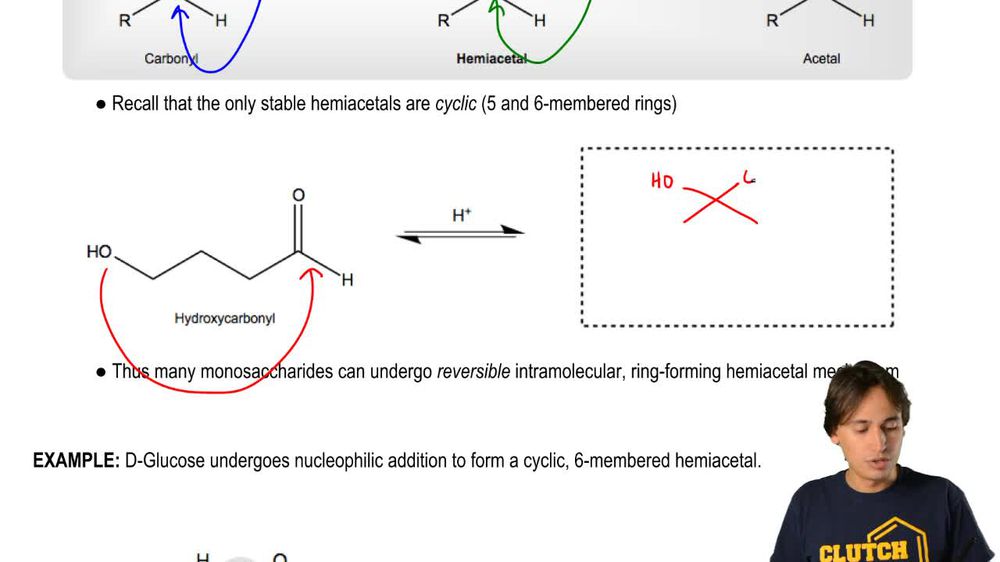
Analyze the structure of glucose: Glucose exists in equilibrium between its open-chain form (which contains an aldehyde group) and its cyclic hemiacetal forms (α and β anomers). The open-chain form is the reactive species for the Tollens test.
Consider the equilibrium: Although the cyclic hemiacetal forms are more stable and predominate at equilibrium, a small amount of the open-chain form is always present in solution due to the dynamic equilibrium between the forms.
Determine the reactivity: The presence of the open-chain form, even in small amounts, means that glucose has an aldehyde group available to react with Tollens reagent. This aldehyde group can be oxidized, leading to a positive Tollens test.
Conclude the explanation: Since the open-chain form of glucose is in equilibrium with the cyclic forms, and the aldehyde group in the open-chain form can reduce Tollens reagent, an aqueous solution of glucose will give a positive Tollens test.
Verified video answer for a similar problem:
This video solution was recommended by our tutors as helpful for the problem above
Video duration:
1m
Play a video:
0 Comments
Key Concepts
Here are the essential concepts you must grasp in order to answer the question correctly.
Cyclic Hemiacetal Formation
Cyclic hemiacetals are formed when an aldehyde reacts with an alcohol, resulting in a ring structure. In the case of glucose, the open-chain form can cyclize to form a six-membered ring (pyranose) or a five-membered ring (furanose). This transformation is crucial because the cyclic form is more stable and predominates in solution, influencing the reactivity of glucose.
Tollens' reagent is a solution of silver nitrate in ammonia, used to test for aldehydes. It oxidizes aldehydes to carboxylic acids while reducing silver ions to metallic silver, resulting in a positive test indicated by a silver mirror. Understanding the reactivity of glucose in its cyclic form is essential to determine if it can reduce Tollens' reagent.
In the context of glucose, the equilibrium between the open-chain and cyclic forms affects its reactivity. Although the cyclic form is more stable and predominates, a small amount of the open-chain form is always present, which is the reactive species that can reduce Tollens' reagent. Thus, the presence of this minor component is key to understanding glucose's ability to give a positive Tollens test.