Draw the structures of the compound α-D-allopyranose. Allose is the C3 epimer of glucose, and ribose is the C2 epimer of arabinose.
Verified step by step guidance
1
Understand the problem: The task is to draw the structure of α-D-allopyranose. Allose is the C3 epimer of glucose, meaning it differs from glucose only at the configuration of the hydroxyl group on carbon 3. Additionally, the term 'α' indicates the anomeric hydroxyl group is in the axial position (down) in the pyranose ring form.
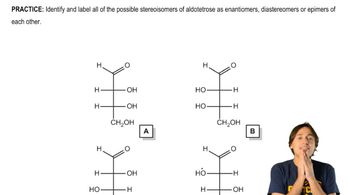
Step 1: Start with the Fischer projection of D-glucose. Identify the configuration of the hydroxyl groups on carbons 1 through 5. For D-glucose, the hydroxyl groups are on the right side for C2, C4, and C5, and on the left side for C3.
Step 2: Modify the Fischer projection of D-glucose to create D-allose. Since allose is the C3 epimer of glucose, flip the hydroxyl group on carbon 3 from the left side to the right side. The configurations of the other carbons remain unchanged.
Step 3: Convert the Fischer projection of D-allose into the Haworth projection of α-D-allopyranose. To do this, cyclize the molecule by forming a bond between the hydroxyl group on C5 and the carbonyl group on C1. Ensure that the anomeric hydroxyl group (on C1) is in the axial position (down) to represent the α-anomer.
Step 4: Verify the stereochemistry of the pyranose ring. Ensure that the hydroxyl groups on C2, C3, and C4 are positioned correctly based on the Fischer projection of D-allose. For D-allose, the hydroxyl groups on C2 and C3 should be equatorial (up), while the hydroxyl group on C4 should be axial (down).
Verified video answer for a similar problem:
This video solution was recommended by our tutors as helpful for the problem above
Video duration:
1m
Play a video:
0 Comments
Key Concepts
Here are the essential concepts you must grasp in order to answer the question correctly.
Epimer
An epimer is a type of stereoisomer that differs in configuration at only one specific carbon atom among multiple chiral centers. In the context of carbohydrates, epimers are important for understanding the structural variations between sugars, such as allose and glucose, which differ at the C3 position.
Pyranose refers to a six-membered cyclic form of sugars that includes five carbon atoms and one oxygen atom. This structure is significant in carbohydrate chemistry as it represents the most stable form of many monosaccharides in solution, influencing their reactivity and interactions.
The anomeric carbon is the carbon atom in a sugar that was the carbonyl carbon in the open-chain form and becomes a new chiral center upon cyclization. In pyranoses, this carbon is crucial for determining the alpha or beta configuration of the sugar, which affects its biological properties and reactivity.