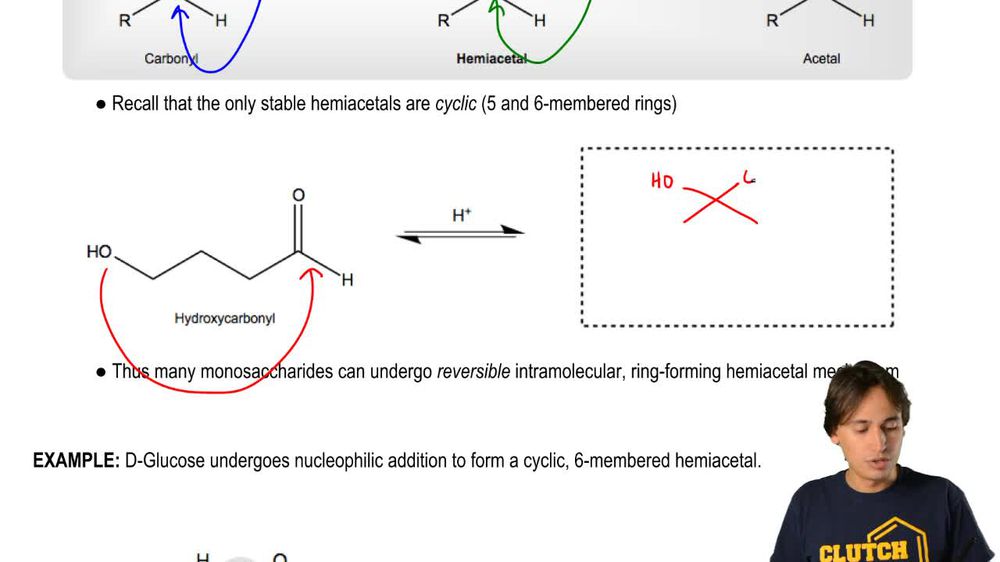
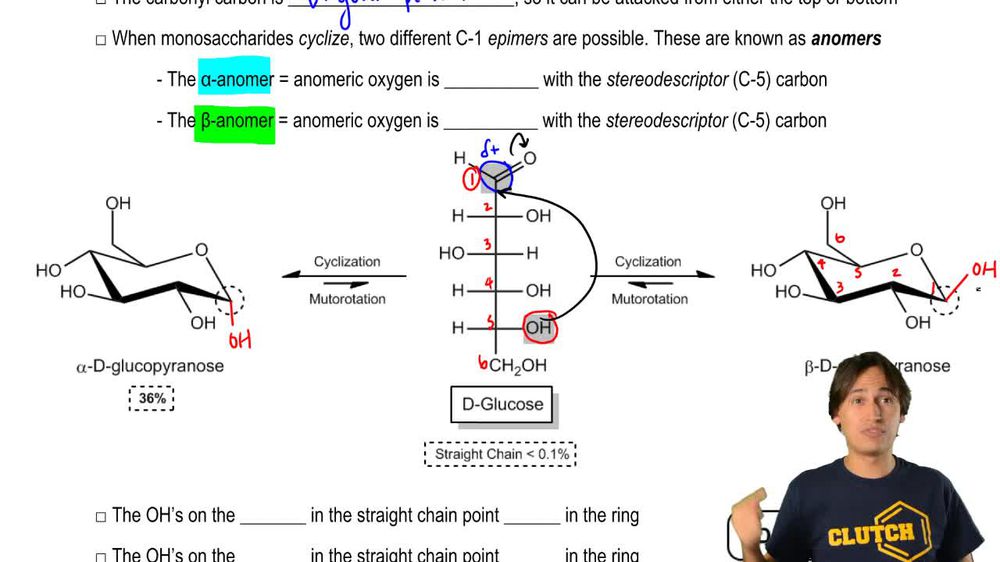
Two structures for the sugar glucose are shown on page 914. Interconversion of the open-chain and cyclic hemiacetal forms is catalyzed by either acid or base. (a) Propose a mechanism for the cyclization, assuming a trace of acid is present.
Verified step by step guidance
1
Step 1: Understand the problem. The question involves two parts: (a) proposing a mechanism for the cyclization of glucose into its cyclic hemiacetal form in the presence of acid, and (b) determining whether the open-chain form of glucose can reduce Tollens' reagent and explaining why.
Step 2: For part (a), recall that the cyclization of glucose involves the reaction of the aldehyde group (in the open-chain form) with a hydroxyl group on the same molecule to form a hemiacetal. In the presence of a trace of acid, the mechanism involves protonation of the carbonyl oxygen, making the carbonyl carbon more electrophilic. This facilitates nucleophilic attack by the hydroxyl group. Write the mechanism step-by-step: (1) Protonation of the carbonyl oxygen, (2) Nucleophilic attack by the hydroxyl group, (3) Formation of the cyclic structure, and (4) Deprotonation to yield the cyclic hemiacetal.
Step 3: For part (b), recall that Tollens' reagent is a mild oxidizing agent that reacts with aldehydes to form carboxylic acids, producing a silver mirror as a positive test. Even though the cyclic hemiacetal form of glucose is more stable and predominant at equilibrium, the open-chain form is in equilibrium with the cyclic form. This means that a small amount of the open-chain form is always present in solution. Since the open-chain form contains an aldehyde group, it can reduce Tollens' reagent.
Step 4: Explain why the equilibrium between the cyclic and open-chain forms allows the Tollens test to be positive. The interconversion between the two forms ensures that as the open-chain form reacts with Tollens' reagent, more of the cyclic form converts to the open-chain form to maintain equilibrium. This continuous supply of the open-chain form allows the reaction with Tollens' reagent to proceed.
Step 5: Summarize the key points: (a) The mechanism for cyclization involves acid-catalyzed protonation, nucleophilic attack, and deprotonation to form the cyclic hemiacetal. (b) An aqueous solution of glucose will give a positive Tollens test because the open-chain form, which contains the aldehyde group, is in equilibrium with the cyclic form and can reduce Tollens' reagent.
Verified video answer for a similar problem:
This video solution was recommended by our tutors as helpful for the problem above
Video duration:
3m
Play a video:
0 Comments
Key Concepts
Here are the essential concepts you must grasp in order to answer the question correctly.
Cyclization of Sugars
Cyclization refers to the process where an open-chain form of a sugar molecule, like glucose, forms a cyclic structure. This occurs when a hydroxyl group reacts with the carbonyl group, leading to the formation of a hemiacetal. In the presence of acid, this reaction is facilitated as the acid protonates the carbonyl oxygen, making it more electrophilic and promoting the nucleophilic attack by the hydroxyl group.
Cyclic hemiacetals, such as the cyclic form of glucose, are generally more stable than their open-chain counterparts due to the formation of a five- or six-membered ring, which minimizes steric strain and allows for favorable intramolecular interactions. This stability means that at equilibrium, the concentration of the cyclic form is significantly higher than that of the open-chain form, influencing the reactivity of the sugar in various chemical tests.
Tollens' test is a qualitative test used to identify aldehydes, which can reduce silver ions in Tollens' reagent to metallic silver. In the case of glucose, although the cyclic form is predominant, it can still interconvert to the open-chain form, which contains an aldehyde group. However, if the equilibrium favors the cyclic form significantly, the amount of open-chain glucose available to reduce Tollens' reagent may be insufficient, potentially leading to a negative test result.