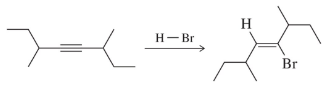
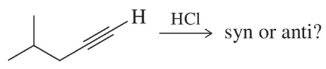
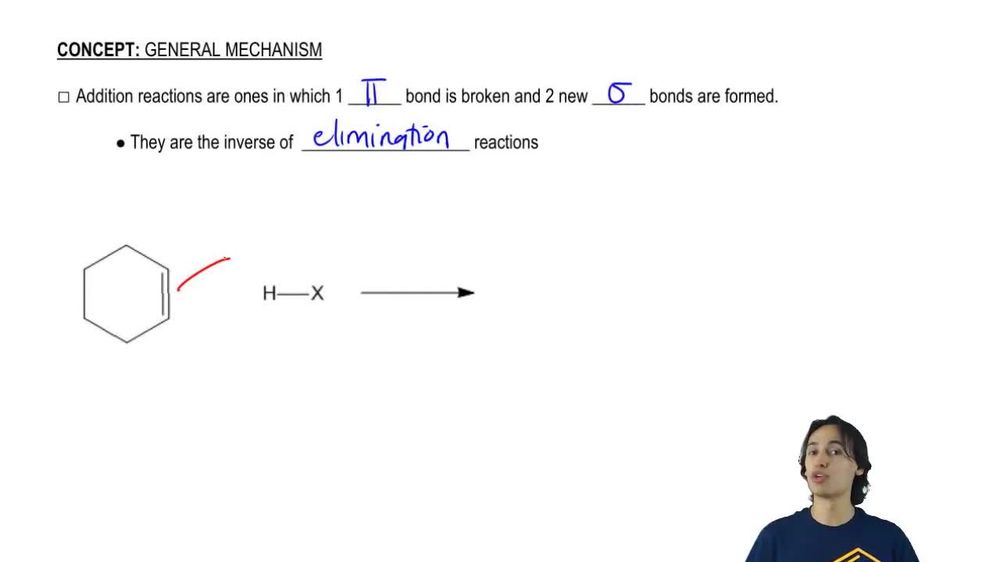
The addition of H―X to alkynes has been shown to occur predominately via anti addition: Two chemists disagreed on whether or not anti addition would happen on terminal alkynes as well. Suggest an experiment through which you could resolve this dispute.
Verified step by step guidance
1
Step 1: Begin by selecting a terminal alkyne as the substrate for the experiment. For example, use 1-butyne or 1-hexyne, which are simple terminal alkynes.
Step 2: React the terminal alkyne with a hydrogen halide (H―X), such as HCl or HBr, under controlled conditions. Ensure the reaction is carried out in a solvent like dichloromethane or acetic acid to facilitate the addition reaction.
Step 3: Analyze the stereochemistry of the product formed using spectroscopic techniques such as Nuclear Magnetic Resonance (NMR) or Infrared (IR) spectroscopy. Look for evidence of anti addition (halogen and hydrogen added to opposite sides of the triple bond) or syn addition (halogen and hydrogen added to the same side).
Step 4: To confirm the stereochemistry further, use X-ray crystallography or compare the product to known stereoisomers if the product is crystalline. This will provide definitive structural information.
Step 5: Repeat the experiment with different hydrogen halides (e.g., HBr, HI) and compare the results to determine if the anti addition mechanism is consistent across various halides or if it varies depending on the halide used.
Verified video answer for a similar problem:
This video solution was recommended by our tutors as helpful for the problem above
Video duration:
6m
Play a video:
0 Comments
Key Concepts
Here are the essential concepts you must grasp in order to answer the question correctly.
Alkynes and Their Reactivity
Alkynes are hydrocarbons containing at least one carbon-carbon triple bond. Their reactivity is significantly influenced by the nature of the triple bond, which can undergo various addition reactions. Understanding the structure and reactivity of terminal and internal alkynes is crucial, as terminal alkynes have a hydrogen atom attached to one end, affecting how they react with electrophiles like H-X.
Anti addition refers to a specific stereochemical outcome in addition reactions where substituents are added to opposite sides of a double or triple bond. This mechanism is important in determining the stereochemistry of the product formed from the reaction of alkynes with reagents like H-X. Recognizing how anti addition occurs can help predict the configuration of the resulting alkyl halide.
To resolve the dispute regarding anti addition in terminal alkynes, an experiment could involve the use of labeled reagents and stereospecific conditions. By performing the addition of H-X to a terminal alkyne and analyzing the product's stereochemistry using techniques like NMR or chiral chromatography, chemists can determine whether the addition occurs anti or not. This experimental approach provides empirical evidence to support or refute the claims of the chemists.