Predict the alkyne and reactants you might use to make the following haloalkenes. [Providing the reactant and the reagent is how we start thinking about synthesis.] (a)
Verified step by step guidance
1
Analyze the given haloalkene structure to determine the position of the halogen atom and the double bond. This will help identify the alkyne precursor and the reaction pathway.
Recall that haloalkenes can be synthesized from alkynes through hydrohalogenation reactions. In this reaction, an alkyne reacts with a hydrogen halide (e.g., HCl, HBr) to form a haloalkene.
Determine the regioselectivity of the reaction. If the reaction follows Markovnikov's rule, the halogen will add to the more substituted carbon of the double bond. If anti-Markovnikov addition is required, a peroxide (e.g., ROOR) is used as a catalyst.
Identify the alkyne that would lead to the given haloalkene. The alkyne should have a triple bond in the position that allows the addition of the hydrogen halide to produce the desired product.
Write the reaction mechanism, showing the addition of the hydrogen halide to the alkyne. Ensure that the intermediate and final product match the structure of the given haloalkene.
Verified video answer for a similar problem:
This video solution was recommended by our tutors as helpful for the problem above
Video duration:
4m
Play a video:
0 Comments
Key Concepts
Here are the essential concepts you must grasp in order to answer the question correctly.
Alkynes
Alkynes are hydrocarbons that contain at least one carbon-carbon triple bond. They are unsaturated compounds and can participate in various chemical reactions, including addition reactions. Understanding the structure and reactivity of alkynes is crucial for predicting the products of synthetic pathways involving haloalkenes.
Haloalkenes, or alkyl halides, are alkenes that contain one or more halogen atoms (such as chlorine, bromine, or iodine) attached to the carbon skeleton. Their reactivity is influenced by the presence of the halogen, which can participate in nucleophilic substitution or elimination reactions. Recognizing how haloalkenes can be synthesized from alkynes is essential for solving the synthesis question.
Synthesis Pathways
Synthesis pathways refer to the step-by-step methods used to construct complex molecules from simpler ones. In organic chemistry, understanding the various reactions, such as elimination and addition, is vital for predicting how to convert alkynes into haloalkenes. Familiarity with common reagents and reaction conditions is necessary for effective synthesis planning.

 4:51 minutes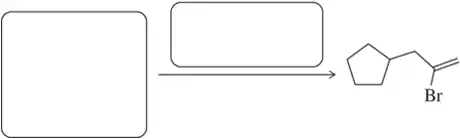
 Verified step by step guidance
 09:11
09:11