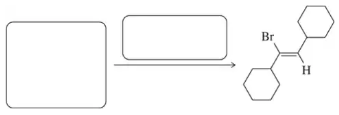
Predict the alkyne and reactants you might use to make the following haloalkenes. [Providing the reactant and the reagent is how we start thinking about synthesis.] (b)
Verified step by step guidance
1
Analyze the target molecule: The product is a haloalkene with a bromine atom attached to a double bond. The structure suggests that the alkyne precursor underwent a selective addition reaction.
Identify the reaction type: To synthesize a haloalkene from an alkyne, a hydrohalogenation reaction is typically used. This involves adding HX (where X is a halogen, such as Br) to the alkyne under controlled conditions to stop at the alkene stage.
Determine the alkyne precursor: The alkyne precursor should have the same carbon skeleton as the product but with a triple bond in place of the double bond. In this case, the alkyne would be 1-cyclohexyl-2-cyclohexylacetylene.
Select the reagent: Use HBr as the reagent for hydrohalogenation. The reaction conditions should be controlled to ensure the addition stops at the alkene stage rather than proceeding to the alkane.
Consider regioselectivity: The Markovnikov rule applies here, meaning the bromine atom will add to the more substituted carbon of the double bond, resulting in the observed product.
Verified video answer for a similar problem:
This video solution was recommended by our tutors as helpful for the problem above
Play a video:
0 Comments
Key Concepts
Here are the essential concepts you must grasp in order to answer the question correctly.
Alkynes
Alkynes are hydrocarbons that contain at least one carbon-carbon triple bond. They are unsaturated compounds and can undergo various reactions, including addition reactions. Understanding the structure and reactivity of alkynes is crucial for predicting the products of synthetic pathways, such as the formation of haloalkenes.
Haloalkenes, or alkyl halides, are alkenes that contain a halogen atom (like bromine) attached to one of the carbon atoms in the double bond. The presence of the halogen influences the reactivity and properties of the compound, making it important to consider when predicting synthesis routes and selecting appropriate reactants.
Synthesis Strategies
Synthesis strategies in organic chemistry involve planning a series of chemical reactions to construct a desired compound from simpler starting materials. This includes identifying the necessary reactants and reagents, as well as understanding the mechanisms of the reactions involved. Effective synthesis requires knowledge of functional group transformations and reaction conditions.