What two carbonyl compounds are required for the synthesis of morachalcone A, via a Claisen–Schmidt condensation? <IMAGE>
Verified step by step guidance
1
Understand the Claisen–Schmidt condensation: This reaction involves the condensation of an aldehyde or ketone with another carbonyl compound in the presence of a base to form an α,β-unsaturated carbonyl compound. Typically, one of the reactants lacks an α-hydrogen to prevent self-condensation.
Analyze the structure of morachalcone A: Morachalcone A is a chalcone, which is an α,β-unsaturated ketone. It has a conjugated system with a double bond between the α and β carbons and a ketone group on the β carbon. Identify the two fragments that could combine to form this structure.
Determine the aromatic aldehyde: The aromatic ring attached to the α-carbon in morachalcone A suggests that one of the starting materials is an aromatic aldehyde. Identify the specific aldehyde based on the substituents on the aromatic ring in morachalcone A.
Determine the ketone: The ketone group in morachalcone A indicates that the second starting material is a ketone. The structure of morachalcone A will help you identify the specific ketone required for the reaction.
Combine the two carbonyl compounds: Write the reaction mechanism for the Claisen–Schmidt condensation, showing the base-catalyzed deprotonation of the ketone to form an enolate ion, followed by nucleophilic attack on the aldehyde, and finally dehydration to form the α,β-unsaturated ketone (morachalcone A).
Verified video answer for a similar problem:
This video solution was recommended by our tutors as helpful for the problem above
Video duration:
3m
Play a video:
0 Comments
Key Concepts
Here are the essential concepts you must grasp in order to answer the question correctly.
Claisen–Schmidt Condensation
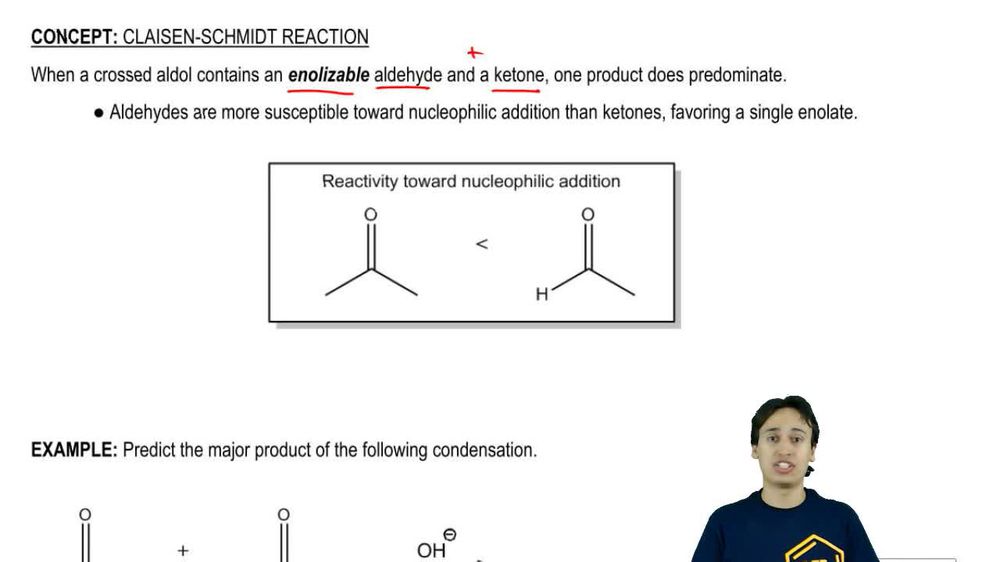
The Claisen–Schmidt condensation is a reaction between an aldehyde and a ketone in the presence of a base, leading to the formation of an α,β-unsaturated carbonyl compound. This reaction involves the nucleophilic attack of the enolate ion derived from one carbonyl compound on the carbonyl carbon of the other, followed by dehydration. Understanding this mechanism is crucial for identifying the specific carbonyl compounds needed for synthesizing morachalcone A.
Carbonyl compounds are organic molecules that contain a carbon atom double-bonded to an oxygen atom (C=O). They include aldehydes, ketones, and carboxylic acids, each with distinct reactivity patterns. In the context of the Claisen–Schmidt condensation, recognizing the types of carbonyl compounds involved is essential for predicting the products and understanding the synthesis of complex molecules like morachalcone A.
Morachalcone A is a specific type of flavonoid compound known for its biological activity and potential therapeutic applications. Its synthesis often involves strategic reactions, such as the Claisen–Schmidt condensation, to construct its carbon skeleton. Identifying the correct carbonyl precursors is vital for successfully synthesizing morachalcone A and understanding its structural features and functions.

 3:12 minutes
 Verified step by step guidance
 02:10
02:10