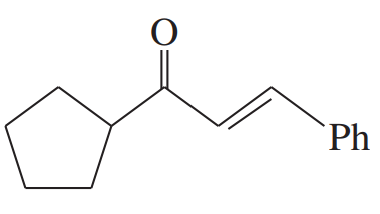
Show how you would use an aldol, Claisen, or another type of condensation to make each compound. (e)
Verified step by step guidance
1
Step 1: Identify the target molecule and recognize the functional groups present. The compound contains a cyclopentanone (a ketone) and an α,β-unsaturated carbonyl system with a phenyl group attached to the β-carbon.
Step 2: Determine the retrosynthetic approach. The α,β-unsaturated ketone can be synthesized via an aldol condensation reaction. This involves the formation of a β-hydroxyketone intermediate, followed by dehydration to yield the conjugated enone.
Step 3: Choose the starting materials. The cyclopentanone will act as the nucleophilic enolate donor, and benzaldehyde (PhCHO) will serve as the electrophilic acceptor in the aldol reaction.
Step 4: Perform the aldol reaction. Under basic conditions, cyclopentanone is deprotonated at the α-carbon to form the enolate ion. The enolate then attacks the carbonyl carbon of benzaldehyde, forming a β-hydroxyketone intermediate.
Step 5: Dehydrate the β-hydroxyketone intermediate. Heat or acidic conditions can be used to eliminate water, resulting in the formation of the α,β-unsaturated ketone with the phenyl group attached to the β-carbon.
Verified video answer for a similar problem:
This video solution was recommended by our tutors as helpful for the problem above
Video duration:
1m
Play a video:
0 Comments
Key Concepts
Here are the essential concepts you must grasp in order to answer the question correctly.
Aldol Condensation
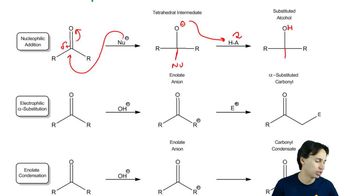
Aldol condensation is a reaction between aldehydes or ketones that contain alpha-hydrogens, leading to the formation of β-hydroxy aldehydes or ketones. This reaction involves the formation of an enolate ion from one carbonyl compound, which then attacks the carbonyl carbon of another, resulting in a β-hydroxy carbonyl compound. Upon heating, this intermediate can dehydrate to form an α,β-unsaturated carbonyl compound, which is often a key step in synthesizing complex organic molecules.
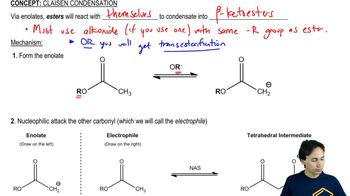
Claisen condensation is a reaction between two esters or an ester and a carbonyl compound in the presence of a strong base, typically an alkoxide. This reaction results in the formation of a β-keto ester or a β-diketone. The mechanism involves the formation of an enolate ion from one ester, which then attacks the carbonyl carbon of the other ester, followed by protonation to yield the final product. This reaction is crucial for building carbon skeletons in organic synthesis.
Condensation reactions are a class of reactions where two molecules combine to form a larger molecule, typically with the loss of a small molecule such as water or methanol. In organic chemistry, these reactions are fundamental for constructing complex molecules and can involve various functional groups. Understanding the conditions and mechanisms of different condensation reactions, such as aldol and Claisen, is essential for effective synthesis in organic chemistry.