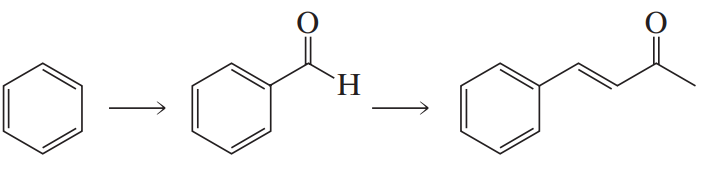
What reagents are required to carry out the following synthesis?
Verified step by step guidance
1
Step 1: Analyze the first transformation (A). The starting material is benzene, and the product is benzaldehyde. This transformation involves the introduction of a formyl group (-CHO) onto the benzene ring. The reaction is typically carried out using the Gattermann-Koch formylation method, which requires carbon monoxide (CO), hydrogen chloride (HCl), and a catalyst such as aluminum chloride (AlCl₃).
Step 2: Analyze the second transformation (B). The starting material is benzaldehyde, and the product is cinnamaldehyde. This transformation involves the formation of a conjugated double bond between the benzene ring and the aldehyde group. This is typically achieved through an aldol condensation reaction, where benzaldehyde reacts with acetaldehyde in the presence of a base such as sodium hydroxide (NaOH) or potassium hydroxide (KOH).
Step 3: For the aldol condensation, ensure that the reaction conditions favor the formation of the α,β-unsaturated aldehyde (cinnamaldehyde). This involves using a catalytic amount of base and controlling the temperature to avoid side reactions.
Step 4: After the aldol condensation, the product may require purification. Techniques such as distillation or recrystallization can be used to isolate cinnamaldehyde from the reaction mixture.
Step 5: Verify the overall synthesis pathway by ensuring that the reagents and conditions used in each step are compatible and lead to the desired product without undesired side reactions.
Verified video answer for a similar problem:
This video solution was recommended by our tutors as helpful for the problem above
Video duration:
4m
Play a video:
0 Comments
Key Concepts
Here are the essential concepts you must grasp in order to answer the question correctly.
Claisen-Schmidt Condensation
The Claisen-Schmidt condensation is a reaction between an aldehyde and a ketone in the presence of a base, leading to the formation of an α,β-unsaturated carbonyl compound. This reaction is a type of aldol condensation where one of the reactants is an aldehyde, and the other is a ketone. Understanding this mechanism is crucial for identifying the reagents needed for the synthesis shown in the question.
The typical reagents required for a Claisen-Schmidt condensation include a strong base, such as sodium ethoxide or sodium hydroxide, and the appropriate aldehyde and ketone. The base deprotonates the aldehyde, generating an enolate ion that can then attack the carbonyl carbon of the ketone, facilitating the condensation reaction. Identifying these reagents is essential for successfully carrying out the synthesis depicted in the image.
Enolate ions are formed when a base abstracts a proton from the α-carbon of a carbonyl compound, resulting in a resonance-stabilized anion. This enolate can act as a nucleophile in various reactions, including the Claisen-Schmidt condensation. Understanding how enolate ions are generated and their role in nucleophilic attacks is vital for comprehending the overall reaction mechanism and predicting the products of the synthesis.