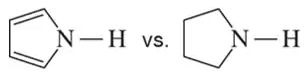
Which acid in each pair would you expect to more readily donate a proton to a basic compound? (a)
Verified step by step guidance
1
Step 1: Analyze the chemical structures provided. The first compound is pyrrole, which has a nitrogen atom in a five-membered aromatic ring. The second compound is pyrrolidine, which has a nitrogen atom in a five-membered saturated ring.
Step 2: Consider the acidity of the compounds. Acidity is influenced by the stability of the conjugate base formed after donating a proton. In pyrrole, the conjugate base is stabilized by resonance because the negative charge on nitrogen can delocalize into the aromatic ring. In pyrrolidine, the conjugate base lacks resonance stabilization.
Step 3: Evaluate the hybridization of the nitrogen atom. In pyrrole, the nitrogen is sp2 hybridized due to its involvement in the aromatic system, which makes the N-H bond more acidic. In pyrrolidine, the nitrogen is sp3 hybridized, which is less acidic.
Step 4: Consider the electron density around the nitrogen atom. In pyrrole, the aromatic ring withdraws electron density from the nitrogen, making it easier to donate a proton. In pyrrolidine, the saturated ring does not have this electron-withdrawing effect.
Step 5: Conclude that pyrrole is more likely to donate a proton to a basic compound compared to pyrrolidine due to the resonance stabilization of its conjugate base and the electron-withdrawing effects of the aromatic ring.
Verified video answer for a similar problem:
This video solution was recommended by our tutors as helpful for the problem above
Play a video:
0 Comments
Key Concepts
Here are the essential concepts you must grasp in order to answer the question correctly.
Acid Strength
Acid strength refers to the ability of an acid to donate protons (H+) to a base. Stronger acids have a greater tendency to lose protons compared to weaker acids. This is often determined by the stability of the conjugate base formed after the proton donation; more stable conjugate bases correspond to stronger acids.
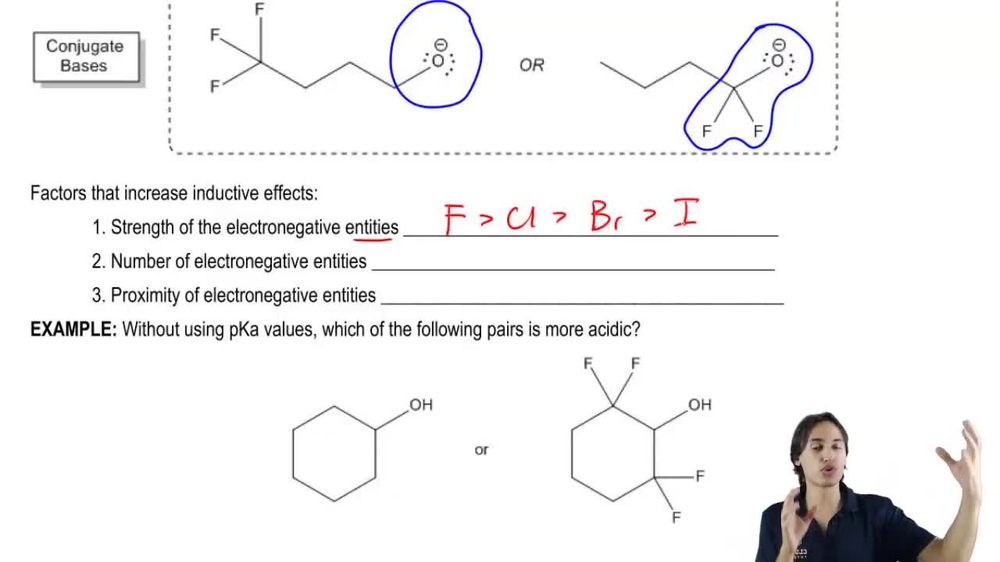
The 3 factors that determine the strength of inductive effects.
Conjugate Base Stability
The stability of a conjugate base is crucial in determining acid strength. Factors such as electronegativity, resonance, and inductive effects influence this stability. A more stable conjugate base will result from a stronger acid, as the equilibrium will favor the dissociation of the acid into its conjugate base and a proton.
The pKa value is a quantitative measure of acid strength, representing the negative logarithm of the acid dissociation constant (Ka). Lower pKa values indicate stronger acids, as they correspond to a higher tendency to donate protons. Comparing pKa values of acids in a pair can help predict which acid is more likely to donate a proton.