Why is the pKa value of protonated hydroxylamine (6.0) so much lower than the value of a protonated primary amine such as protonated methylamine (10.7)?
Verified step by step guidance
1
Understand the concept of pKa: The pKa value indicates the strength of an acid. A lower pKa value corresponds to a stronger acid, meaning the compound is more likely to donate a proton.
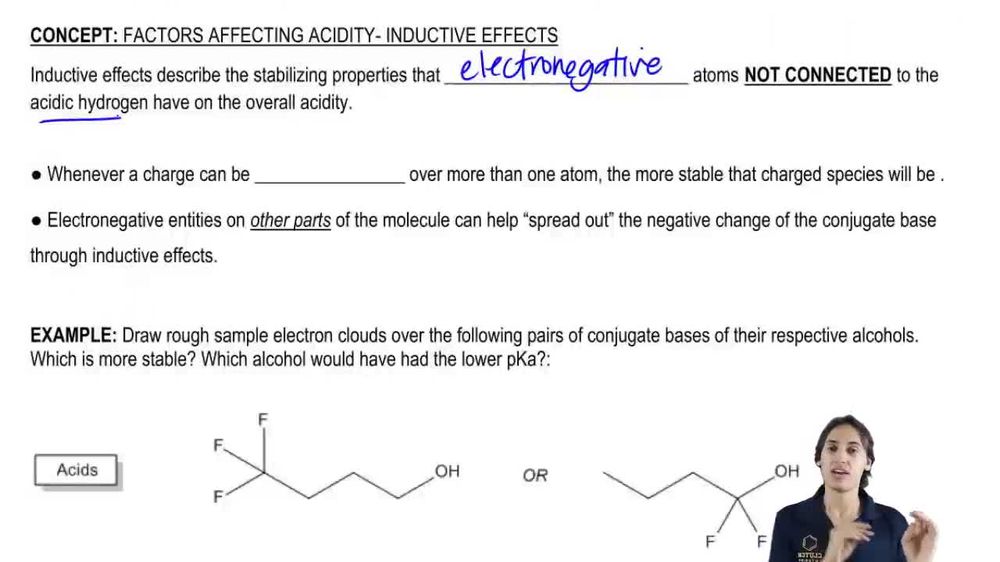
Examine the structure of protonated hydroxylamine: Protonated hydroxylamine has an -OH group attached to the nitrogen atom. The electronegativity of oxygen increases the electron-withdrawing effect, stabilizing the conjugate base after deprotonation and making the protonated form more acidic (lower pKa).
Compare with protonated methylamine: Protonated methylamine has a methyl group (-CH3) attached to the nitrogen atom. The methyl group is electron-donating, which destabilizes the conjugate base after deprotonation, making the protonated form less acidic (higher pKa).
Consider resonance and inductive effects: In protonated hydroxylamine, the lone pairs on the oxygen atom can interact with the nitrogen atom, further stabilizing the conjugate base. This effect is absent in protonated methylamine, contributing to the difference in pKa values.
Summarize the reasoning: The lower pKa value of protonated hydroxylamine compared to protonated methylamine is due to the electron-withdrawing effect of the -OH group and the stabilization of the conjugate base through resonance and inductive effects, making protonated hydroxylamine a stronger acid.
Verified video answer for a similar problem:
This video solution was recommended by our tutors as helpful for the problem above
Video duration:
5m
Play a video:
0 Comments
Key Concepts
Here are the essential concepts you must grasp in order to answer the question correctly.
Protonation and pKa Values
Protonation refers to the addition of a proton (H+) to a molecule, which can significantly affect its acidity and basicity. The pKa value is a quantitative measure of the strength of an acid in solution; lower pKa values indicate stronger acids. In this context, the pKa values of protonated hydroxylamine and protonated methylamine reflect their relative stabilities and tendencies to donate protons.
Resonance stabilization occurs when a molecule can be represented by multiple valid Lewis structures, allowing for the delocalization of electrons. In the case of protonated hydroxylamine, the positive charge can be delocalized over the nitrogen and oxygen atoms, which can lead to a less stable structure compared to protonated methylamine, where the positive charge is localized on the nitrogen atom.
Inductive effects refer to the electron-withdrawing or electron-donating effects of substituents on a molecule, which can influence its acidity or basicity. In protonated methylamine, the alkyl group can donate electron density to the nitrogen, stabilizing the positive charge. In contrast, the presence of the electronegative oxygen in protonated hydroxylamine can withdraw electron density, making it less stable and resulting in a lower pKa.