

Starting from bromobenzene and any other reagents and solvents you need, show how you would synthesize the following compounds. Any of these products may be used as starting materials in subsequent parts of this problem. a. 1-phenylpropan-1-ol
Verified step by step guidance
1
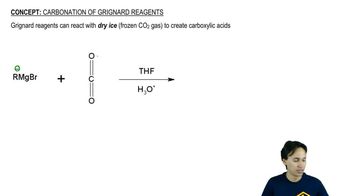
Step 1: Begin with bromobenzene (C₆H₅Br) as the starting material. Perform a Grignard reaction by reacting bromobenzene with magnesium (Mg) in anhydrous ether to form phenylmagnesium bromide (C₆H₅MgBr), a Grignard reagent.
Step 2: Prepare propanal (CH₃CH₂CHO) as the electrophile. This can be purchased or synthesized separately if needed.
Step 3: React the Grignard reagent (C₆H₅MgBr) with propanal (CH₃CH₂CHO) in an anhydrous ether solvent. The Grignard reagent will act as a nucleophile, attacking the carbonyl carbon of propanal to form an intermediate alkoxide.
Step 4: Perform an acidic workup by adding a dilute acid (e.g., HCl or H₂SO₄) to the reaction mixture. This will protonate the alkoxide intermediate, yielding 1-phenylpropan-1-ol (C₆H₅CH₂CH₂OH) as the final product.
Step 5: Purify the product using standard techniques such as distillation or recrystallization, depending on the physical properties of the compound.
Verified video answer for a similar problem:
This video solution was recommended by our tutors as helpful for the problem above
Video duration:
6m
Play a video:
0 Comments
Key Concepts
Here are the essential concepts you must grasp in order to answer the question correctly.
Nucleophilic Substitution
Nucleophilic substitution is a fundamental reaction in organic chemistry where a nucleophile replaces a leaving group in a molecule. In the case of bromobenzene, the bromine atom can be replaced by a nucleophile, such as an alkoxide ion, to form a new carbon-oxygen bond. Understanding this mechanism is crucial for synthesizing alcohols from aryl halides.
Nucleophiles and Electrophiles can react in Substitution Reactions.
Grignard Reagents
Grignard reagents are organomagnesium compounds that act as strong nucleophiles in organic synthesis. They can react with carbonyl compounds to form alcohols. In the synthesis of 1-phenylpropan-1-ol, a Grignard reagent derived from bromobenzene can be used to add to an appropriate carbonyl compound, facilitating the formation of the desired alcohol.
Rearrangement reactions involve the structural reorganization of a molecule to form a new compound. In the synthesis of 1-phenylpropan-1-ol, understanding how to manipulate the carbon skeleton through rearrangements can be essential, especially when considering the formation of intermediates that may lead to the final product. This concept is vital for predicting the outcome of synthetic pathways.