Ch. 13 - Alcohols, Ethers and Related Compounds: Substitution and Elimination
Mullins - Organic Chemistry: A Learner Centered Approach 1st Edition
Mullins1st EditionOrganic Chemistry: A Learner Centered ApproachISBN: 9780137566471Not the one you use?Change textbook
Chapter 12, Problem 13b

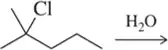
Predict the product of each of the following alcohol synthesis reactions.
(b)

Verified step by step guidance
1
Identify the type of alcohol synthesis reaction. Common methods include reduction of carbonyl compounds, hydroboration-oxidation of alkenes, or substitution reactions involving alkyl halides.
Examine the starting material and reagents provided in the reaction. For example, if the starting material is a carbonyl compound (aldehyde or ketone) and the reagent is NaBH4 or LiAlH4, the reaction involves reduction to form an alcohol.
Determine the regioselectivity and stereoselectivity of the reaction, if applicable. For instance, hydroboration-oxidation of an alkene adds the hydroxyl group (-OH) to the less substituted carbon (anti-Markovnikov addition) and occurs with syn stereochemistry.
Draw the intermediate or transition state, if necessary, to understand how the reaction proceeds. For example, in hydroboration, the boron atom adds to the less substituted carbon of the alkene, followed by oxidation to replace the boron with a hydroxyl group.
Predict the final product by applying the reaction mechanism and considering any stereochemical outcomes. Ensure that the functional group transformations and connectivity of the molecule are consistent with the reaction conditions.

Verified video answer for a similar problem:

This video solution was recommended by our tutors as helpful for the problem above.
Video duration:
6m
Was this helpful?

Key Concepts

Here are the essential concepts you must grasp in order to answer the question correctly.

Alcohol Synthesis

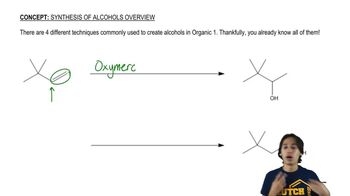
Alcohol synthesis refers to the various chemical reactions and methods used to produce alcohols from different starting materials. This can include reactions such as hydration of alkenes, reduction of carbonyl compounds, or substitution reactions involving alkyl halides. Understanding the mechanisms and conditions for these reactions is crucial for predicting the products formed.
Recommended video:
Guided course
02:26
Forming alcohols through Oxymercuration-Reduction.

Reaction Mechanisms

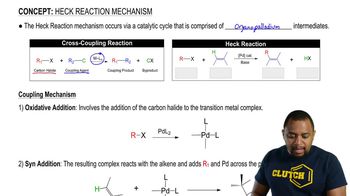
A reaction mechanism is a step-by-step description of the process by which reactants are converted into products. It outlines the sequence of elementary steps, including bond breaking and formation, and the intermediates involved. Familiarity with common mechanisms, such as nucleophilic substitution or elimination, is essential for predicting the outcomes of alcohol synthesis reactions.
Recommended video:
Guided course
02:16
Heck Reaction Mechanism

Functional Group Transformation

Functional group transformation involves the conversion of one functional group into another through chemical reactions. In the context of alcohol synthesis, this may include the transformation of alkenes or carbonyls into alcohols. Recognizing how different functional groups can be interconverted is vital for understanding the products of synthesis reactions.
Recommended video:
Guided course
02:36
Identifying Functional Groups