Draw the structure for a compound with molecular formula C2H2I2F2 a. that is optically inactive because it does not have an asymmetric center. b. that is optically inactive because it is a meso compound.
Verified step by step guidance
1
Step 1: Understand the molecular formula C2H2I2F2. This indicates the compound contains 2 carbon atoms, 2 hydrogen atoms, 2 iodine atoms, and 2 fluorine atoms. The task is to draw two different structures based on optical inactivity criteria.
Step 2: For part (a), identify a structure that is optically inactive due to the absence of an asymmetric center. An asymmetric center is a carbon atom bonded to four different groups. To ensure optical inactivity, arrange the substituents (I, F, H) symmetrically around the two carbon atoms, such that neither carbon atom has four different groups attached.
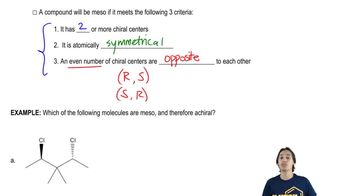
Step 3: For part (b), identify a structure that is optically inactive because it is a meso compound. A meso compound has multiple stereocenters but possesses an internal plane of symmetry, making it optically inactive. Arrange the substituents (I, F, H) around the two carbon atoms such that the molecule has stereocenters but also an internal plane of symmetry.
Step 4: Draw the structure for part (a). Place the two carbon atoms in the center, and attach the substituents symmetrically (e.g., one iodine and one fluorine on each carbon atom, with hydrogens completing the bonds). Ensure no asymmetric centers are present.
Step 5: Draw the structure for part (b). Place the two carbon atoms in the center, and arrange the substituents (e.g., one iodine and one fluorine on each carbon atom) such that the molecule has stereocenters but also an internal plane of symmetry. Verify that the structure meets the criteria for a meso compound.
Verified video answer for a similar problem:
This video solution was recommended by our tutors as helpful for the problem above
Video duration:
2m
Play a video:
0 Comments
Key Concepts
Here are the essential concepts you must grasp in order to answer the question correctly.
Optical Activity
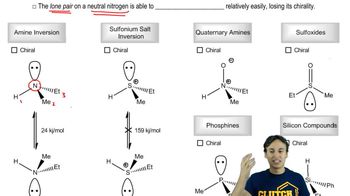
Optical activity refers to the ability of a compound to rotate plane-polarized light. This property is typically observed in chiral molecules, which possess an asymmetric center (a carbon atom bonded to four different groups). Compounds that are optically inactive either lack chirality or have a specific symmetry that cancels out their optical activity.
Chirality is a geometric property of some molecules that makes them non-superimposable on their mirror images, akin to left and right hands. An asymmetric center, usually a carbon atom, is bonded to four distinct substituents, leading to two enantiomers. A compound without an asymmetric center cannot exhibit optical activity, making it optically inactive.
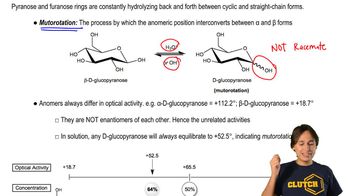
Meso compounds are a specific type of stereoisomer that contain multiple chiral centers but are achiral due to an internal plane of symmetry. This symmetry results in the cancellation of optical activity, even though the compound has chiral centers. Meso compounds are important in understanding how molecular symmetry influences optical properties.