When 2-bromopropane is treated with sodium ethoxide, propene is produced. What molecule is lost from 2-bromopropane in this process?
Verified step by step guidance
1
Step 1: Recognize the type of reaction occurring. This is an elimination reaction (E2 mechanism), where a molecule is lost from the substrate to form a double bond.
Step 2: Identify the substrate, 2-bromopropane, and note that it contains a bromine atom attached to the second carbon of a propane chain.
Step 3: Understand the role of sodium ethoxide (NaOCH₂CH₃). It acts as a strong base, abstracting a proton (H⁺) from a β-carbon (the carbon adjacent to the carbon bonded to bromine).
Step 4: Determine the molecule lost during the reaction. The bromine atom leaves as a bromide ion (Br⁻), and a proton (H⁺) is abstracted from the β-carbon, resulting in the formation of propene (CH₃-CH=CH₂). The lost molecule is HBr (hydrogen bromide).
Step 5: Summarize the process: Sodium ethoxide facilitates the elimination of HBr from 2-bromopropane, leading to the formation of propene via the E2 mechanism.
Verified video answer for a similar problem:
This video solution was recommended by our tutors as helpful for the problem above
Video duration:
4m
Play a video:
0 Comments
Key Concepts
Here are the essential concepts you must grasp in order to answer the question correctly.
Elimination Reactions
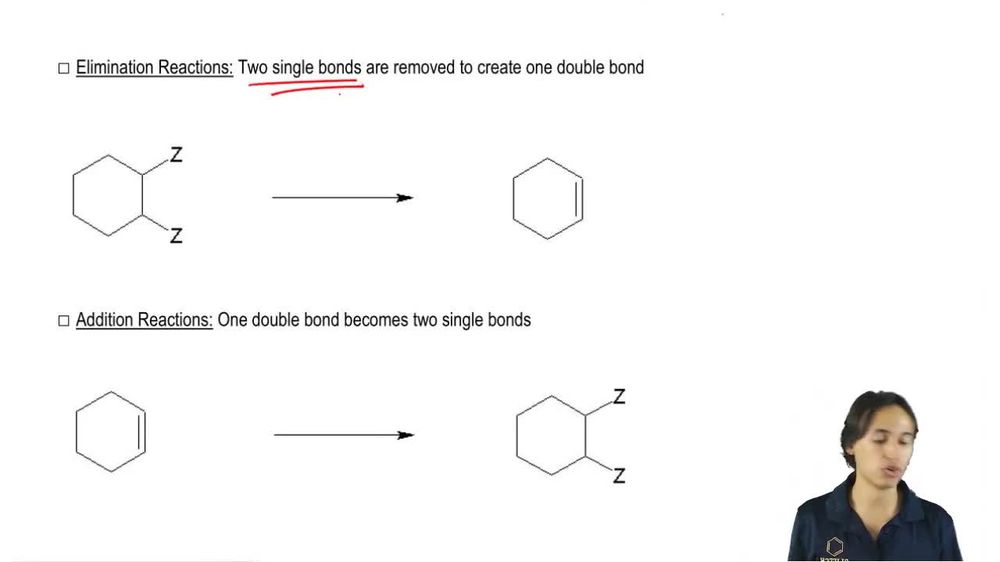
Elimination reactions involve the removal of a small molecule from a larger one, resulting in the formation of a double bond. In the case of 2-bromopropane reacting with sodium ethoxide, an elimination reaction occurs, leading to the formation of propene. Understanding the mechanism of elimination is crucial for predicting the products of such reactions.
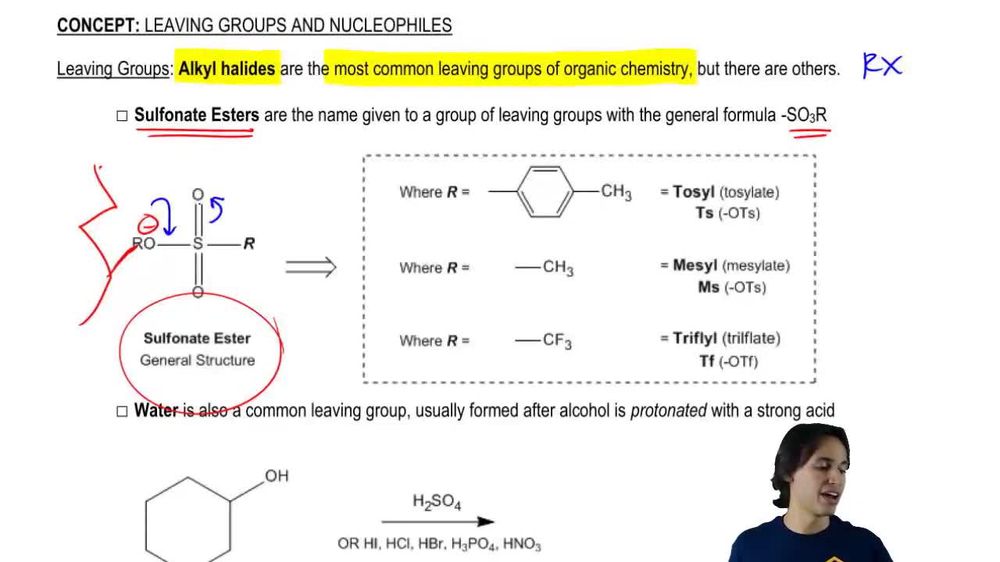
A leaving group is an atom or group that can depart from the parent molecule during a chemical reaction. In the context of 2-bromopropane, the bromine atom acts as a leaving group when the sodium ethoxide facilitates the elimination process. The stability and ability of the leaving group to depart significantly influence the reaction's efficiency.
Base-induced elimination refers to the process where a strong base, such as sodium ethoxide, abstracts a proton from a β-carbon, leading to the formation of a double bond. This mechanism is essential in understanding how propene is generated from 2-bromopropane, as the base facilitates the removal of a hydrogen atom alongside the leaving group.