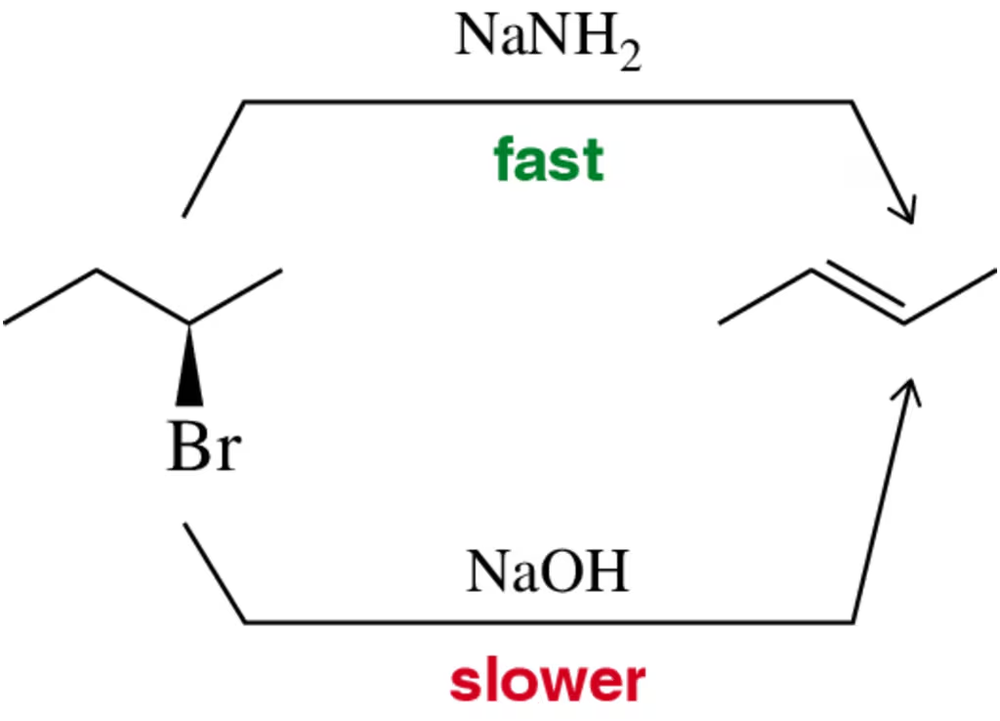
Justify on a reaction coordinate diagram the fact that a strong base like sodium amide (NaNH2) results in a faster E2 elimination than does sodium hydroxide (NaOH).
Verified step by step guidance
1
Understand the concept of E2 elimination: E2 elimination is a bimolecular reaction where a base abstracts a proton from a β-carbon, and simultaneously, the leaving group departs from the α-carbon, forming a double bond. The reaction rate depends on the strength of the base and the ability to abstract the proton efficiently.
Compare the basicity of sodium amide (NaNH₂) and sodium hydroxide (NaOH): Sodium amide is a stronger base than sodium hydroxide because the conjugate acid of NaNH₂ (NH₃) is less acidic than the conjugate acid of NaOH (H₂O). This means NaNH₂ has a higher tendency to abstract protons.
Relate basicity to the reaction coordinate diagram: A stronger base like NaNH₂ lowers the activation energy (ΔG‡) for the E2 elimination process because it can more effectively abstract the β-hydrogen, making the transition state easier to achieve. This results in a faster reaction rate.
Illustrate the reaction coordinate diagram: On the diagram, the y-axis represents the free energy, and the x-axis represents the reaction progress. The curve for NaNH₂ will show a lower activation energy peak compared to NaOH, indicating a faster reaction due to the stronger base.
Conclude the justification: The faster E2 elimination with NaNH₂ compared to NaOH is due to the stronger basicity of NaNH₂, which reduces the energy barrier for the reaction. This is reflected in the reaction coordinate diagram by a lower activation energy for the transition state when NaNH₂ is used.
Verified video answer for a similar problem:

This video solution was recommended by our tutors as helpful for the problem above
Play a video:
0 Comments
Key Concepts
Here are the essential concepts you must grasp in order to answer the question correctly.
E2 Elimination Mechanism
The E2 elimination mechanism is a bimolecular reaction where a strong base abstracts a proton from a substrate while a leaving group departs simultaneously. This concerted process results in the formation of a double bond. The rate of an E2 reaction depends on the strength of the base and the stability of the leaving group, making the choice of base critical for reaction speed.
A reaction coordinate diagram visually represents the energy changes during a chemical reaction. It plots the energy of the system against the progress of the reaction, illustrating the transition states and intermediates. In the context of E2 eliminations, the diagram helps to compare the activation energies of reactions involving different bases, highlighting how a stronger base can lower the energy barrier and accelerate the reaction.
Base strength is a measure of a base's ability to accept protons, while nucleophilicity refers to a species' ability to donate electron pairs. Sodium amide (NaNH₂) is a stronger base than sodium hydroxide (NaOH), making it more effective at deprotonating substrates in E2 reactions. This increased basicity leads to a lower activation energy and a faster reaction rate, as depicted in the reaction coordinate diagram.