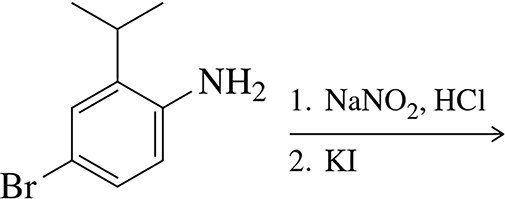
Predict the products of the following reactions. (a)
Verified step by step guidance
1
Identify the starting material: The given compound is a brominated aniline derivative with a methyl group on the benzene ring.
Recognize the reaction type: The reaction involves diazotization followed by a substitution reaction. The first step uses NaNO2 and HCl to convert the amine group (NH2) into a diazonium salt.
Write the diazotization reaction: The amine group reacts with NaNO2 and HCl to form an aryl diazonium ion (N2+), releasing water as a byproduct.
Consider the substitution step: The diazonium ion is highly reactive and can be replaced by other nucleophiles. In this case, KI is used to replace the diazonium group with an iodine atom.
Predict the final product: The final product will have the iodine atom in place of the original amine group, while the bromine and methyl groups remain unchanged on the benzene ring.
Verified video answer for a similar problem:
This video solution was recommended by our tutors as helpful for the problem above
Play a video:
0 Comments
Key Concepts
Here are the essential concepts you must grasp in order to answer the question correctly.
Aromatic Substitution Reactions
Aromatic substitution reactions involve the replacement of a hydrogen atom in an aromatic ring with another substituent. These reactions typically occur via electrophilic aromatic substitution (EAS), where an electrophile attacks the electron-rich aromatic system. Understanding the mechanism of EAS is crucial for predicting the products of reactions involving aromatic compounds.
Diazotization is a process where primary amines are converted into diazonium salts using nitrous acid (generated from sodium nitrite and hydrochloric acid). This reaction is significant in organic synthesis as diazonium salts can undergo further reactions, such as nucleophilic substitution, to form various aromatic compounds. Recognizing the role of diazonium intermediates is essential for predicting the final products.
Nucleophilic substitution is a reaction where a nucleophile replaces a leaving group in a molecule. In the context of the provided reaction, the iodide ion (from KI) acts as a nucleophile that replaces the bromine atom in the diazonium compound. Understanding the conditions and mechanisms of nucleophilic substitution helps in predicting the outcome of reactions involving halogenated aromatic compounds.