Ch. 19 - Amines
Wade - Organic Chemistry 9th Edition
Wade9th EditionOrganic ChemistryISBN: 9780135213728Not the one you use?Change textbook
Chapter 19, Problem 23d

Predict the products from the reactions of the following amines with sodium nitrite in dilute HCl.
(d) aniline

Verified step by step guidance
1
Step 1: Recognize the functional group in aniline. Aniline is an aromatic amine with the structure C₆H₅NH₂, where the amino group (-NH₂) is directly attached to a benzene ring.
Step 2: Understand the reaction conditions. Sodium nitrite (NaNO₂) in dilute HCl generates nitrous acid (HNO₂) in situ. This is a key reagent for diazotization reactions, which occur with primary aromatic amines like aniline.
Step 3: Write the diazotization reaction. The amino group (-NH₂) of aniline reacts with nitrous acid (HNO₂) under acidic conditions to form a diazonium salt. The reaction can be represented as: C₆H₅NH₂ + HNO₂ + HCl → C₆H₅N₂⁺Cl⁻ + 2H₂O.
Step 4: Identify the product. The product of this reaction is benzenediazonium chloride (C₆H₅N₂⁺Cl⁻), which is a diazonium salt. This compound is highly reactive and can undergo further reactions, depending on the conditions.
Step 5: Note the importance of temperature. Diazotization reactions are typically carried out at low temperatures (0–5°C) to stabilize the diazonium salt and prevent its decomposition.

Verified video answer for a similar problem:

This video solution was recommended by our tutors as helpful for the problem above.
Video duration:
7m
Was this helpful?

Key Concepts

Here are the essential concepts you must grasp in order to answer the question correctly.

Amines

Amines are organic compounds derived from ammonia (NH3) by replacing one or more hydrogen atoms with alkyl or aryl groups. They can be classified as primary, secondary, or tertiary based on the number of carbon-containing groups attached to the nitrogen atom. Aniline, specifically, is a primary aromatic amine where the amino group (-NH2) is directly attached to a benzene ring.
Recommended video:
Guided course
07:12
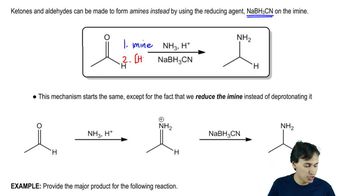
Reductive Amination

Diazotization

Diazotization is a chemical reaction that involves the conversion of primary amines into diazonium salts by treatment with nitrous acid (generated in situ from sodium nitrite and hydrochloric acid). This reaction is crucial in organic synthesis, particularly for the preparation of azo compounds, which are important in dye chemistry. In the case of aniline, the amino group reacts with nitrous acid to form benzenediazonium chloride.
Recommended video:
Guided course
06:59
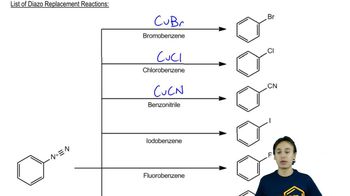
Replacement Reactions

Electrophilic Aromatic Substitution

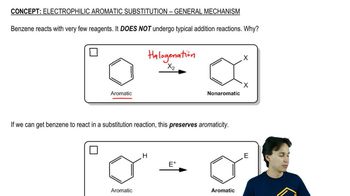
Electrophilic aromatic substitution (EAS) is a fundamental reaction mechanism in organic chemistry where an electrophile replaces a hydrogen atom on an aromatic ring. The presence of the amino group in aniline activates the benzene ring towards electrophilic attack, making it more reactive. After diazotization, the diazonium salt can undergo further reactions, such as substitution with nucleophiles, leading to various aromatic derivatives.
Recommended video: