Predict the products of the following reactions: (c)
Verified step by step guidance
1
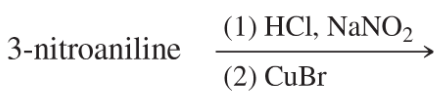
Step 1: Analyze the starting material. The molecule is a nitroaniline, specifically 2-nitroaniline, with an amino group (-NH₂) at the ortho position relative to the nitro group (-NO₂) on a benzene ring.
Step 2: Understand the reaction conditions. The first step involves sodium nitrite (NaNO₂) and hydrochloric acid (HCl), which are used to convert the amino group (-NH₂) into a diazonium salt (-N₂⁺Cl⁻). This is known as diazotization.
Step 3: Write the intermediate structure. After diazotization, the amino group is replaced by a diazonium group (-N₂⁺Cl⁻), resulting in 2-nitrobenzenediazonium chloride.
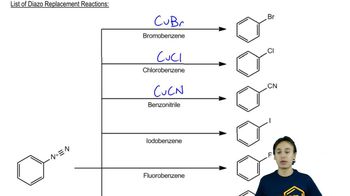
Step 4: Examine the second reagent, CuBr. Copper(I) bromide (CuBr) facilitates a Sandmeyer reaction, where the diazonium group (-N₂⁺Cl⁻) is replaced by a bromine atom (-Br). This substitution occurs via a radical mechanism.
Step 5: Predict the final product. The bromine atom replaces the diazonium group, yielding 2-nitrobromobenzene as the final product. The nitro group (-NO₂) remains unchanged during the reaction.
Verified video answer for a similar problem:
This video solution was recommended by our tutors as helpful for the problem above
Video duration:
3m
Play a video:
0 Comments
Key Concepts
Here are the essential concepts you must grasp in order to answer the question correctly.
Diazotization
Diazotization is a chemical reaction that involves converting an amine group (-NH2) into a diazonium salt (-N2+). This is typically achieved by treating the amine with sodium nitrite (NaNO2) in the presence of a strong acid like hydrochloric acid (HCl). The resulting diazonium salt is a key intermediate in various organic reactions, allowing for further substitution reactions.
Nucleophilic substitution is a fundamental reaction mechanism in organic chemistry where a nucleophile attacks an electrophile, resulting in the replacement of a leaving group. In the context of diazonium salts, the nitrogen gas (N2) leaves, and a nucleophile, such as bromide ion (Br-) from CuBr, can replace it, leading to the formation of a new compound. This reaction is crucial for introducing different functional groups into aromatic systems.
Nucleophiles and Electrophiles can react in Substitution Reactions.
Aromatic Compounds
Aromatic compounds are a class of cyclic compounds characterized by their stable ring structure and delocalized π-electrons, which follow Huckel's rule (4n + 2 π electrons). The presence of substituents, such as -NH2 and -NO2, can influence the reactivity and stability of these compounds. Understanding the electronic effects of these substituents is essential for predicting the outcomes of reactions involving aromatic systems.