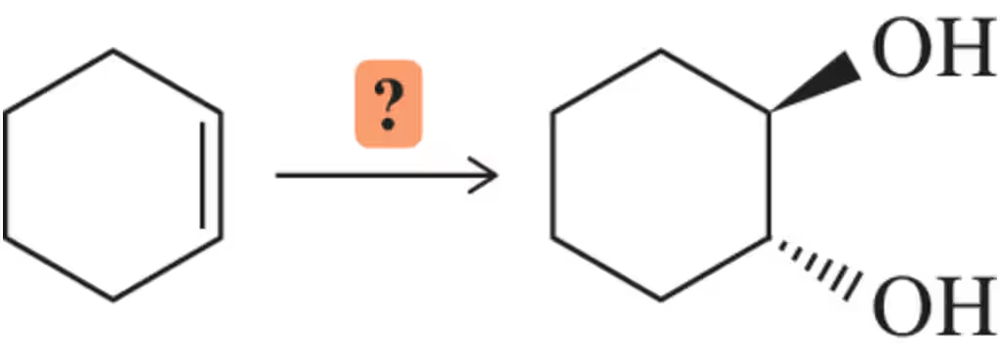
The concertedness of the OsO4 reaction results in both oxygens being added to the same face of the molecule (i.e., syn addition). How might these conditions be modified in order to prepare a trans-diol?
Verified step by step guidance
1
Understand the reaction: The OsO₄ reaction is a syn-dihydroxylation, meaning both hydroxyl groups are added to the same face of the alkene. This is due to the concerted mechanism of the reaction, where the osmium tetroxide adds to the π-bond in a single step.
Recognize the goal: To prepare a trans-diol, the hydroxyl groups must be added to opposite faces of the molecule (anti addition). This requires a different reaction mechanism or reagent.
Consider an alternative reaction: One common method to achieve anti-dihydroxylation is through the epoxidation of the alkene followed by acid-catalyzed ring opening. This involves two steps: (1) formation of an epoxide and (2) hydrolysis of the epoxide under acidic conditions.
Step 1: Use a peracid (e.g., mCPBA) to convert the alkene into an epoxide. The epoxide is a three-membered cyclic ether that forms via a concerted mechanism, maintaining the stereochemistry of the starting alkene.
Step 2: Perform an acid-catalyzed ring opening of the epoxide. Protonation of the epoxide makes it more electrophilic, and water or another nucleophile attacks the more substituted carbon (if regioselectivity is relevant), leading to anti addition of hydroxyl groups and forming the trans-diol.
Verified video answer for a similar problem:
This video solution was recommended by our tutors as helpful for the problem above
Video duration:
4m
Play a video:
0 Comments
Key Concepts
Here are the essential concepts you must grasp in order to answer the question correctly.
Syn Addition
Syn addition refers to the process where two substituents are added to the same side of a double bond in a molecule. In the context of the OsO₄ reaction, this means that both oxygen atoms are added to the same face of the alkene, resulting in a syn-diol. Understanding this concept is crucial for grasping how stereochemistry is affected during reactions involving alkenes.
Trans-diols are formed when two hydroxyl groups are added to opposite sides of a double bond. To achieve this from an OsO₄ reaction, one must modify the reaction conditions, such as using a different reagent or reaction pathway that allows for anti addition. This concept is essential for understanding how to manipulate reaction conditions to achieve desired stereochemical outcomes.
The choice of reagents and specific reaction conditions can significantly influence the outcome of organic reactions. In the case of forming a trans-diol, alternative reagents like peracids or using a two-step process with different conditions can facilitate anti addition. Recognizing how these factors interact is vital for predicting and controlling the stereochemistry of organic transformations.