Draw all possible stereoisomers for each of the following: b. 2-bromo-4-chlorohexane
Verified step by step guidance
1
Identify the chiral centers in the molecule. For 2-bromo-4-chlorohexane, the carbon atoms at positions 2 and 4 are chiral because they are bonded to four different groups.
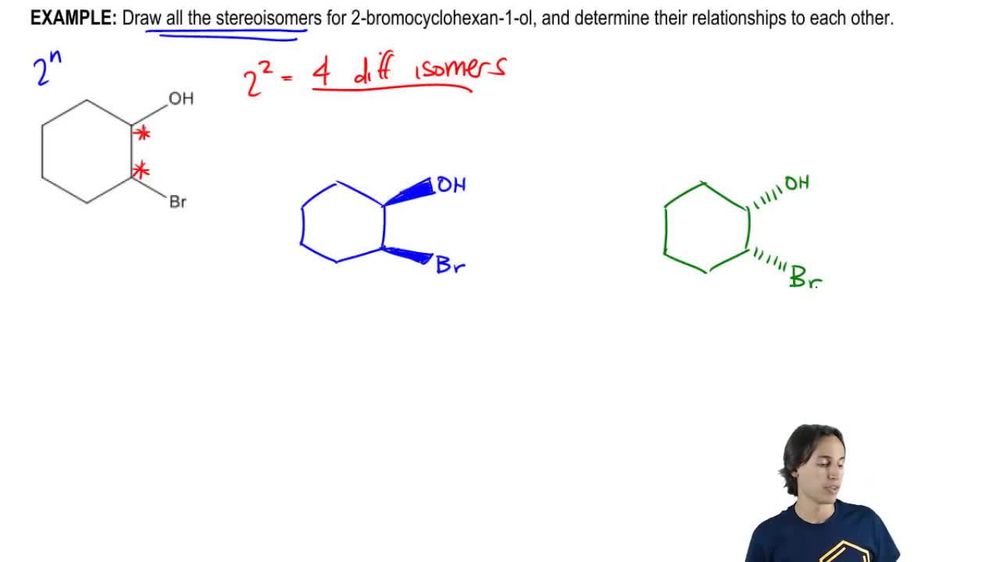
Determine the number of possible stereoisomers. The formula for calculating the number of stereoisomers is 2ⁿ, where n is the number of chiral centers. Since there are 2 chiral centers, the molecule can have 2² = 4 stereoisomers.
Assign the possible configurations (R or S) to each chiral center. For the carbon at position 2, consider the priority of the groups attached (Br, H, CH₃, and the rest of the chain). Similarly, assign configurations for the carbon at position 4 (Cl, H, and the two different alkyl groups).
Draw the Fischer projections or 3D representations for each stereoisomer. For example, one stereoisomer could have the configuration (R,R), another (R,S), another (S,R), and the last (S,S). Ensure that the spatial arrangement of substituents is clear in each drawing.
Label each stereoisomer with its specific configuration (e.g., (R,R), (R,S), etc.) and verify that all four possible combinations of configurations are represented. This ensures that all stereoisomers have been accounted for.
Verified video answer for a similar problem:
This video solution was recommended by our tutors as helpful for the problem above
Video duration:
3m
Play a video:
0 Comments
Key Concepts
Here are the essential concepts you must grasp in order to answer the question correctly.
Stereoisomerism
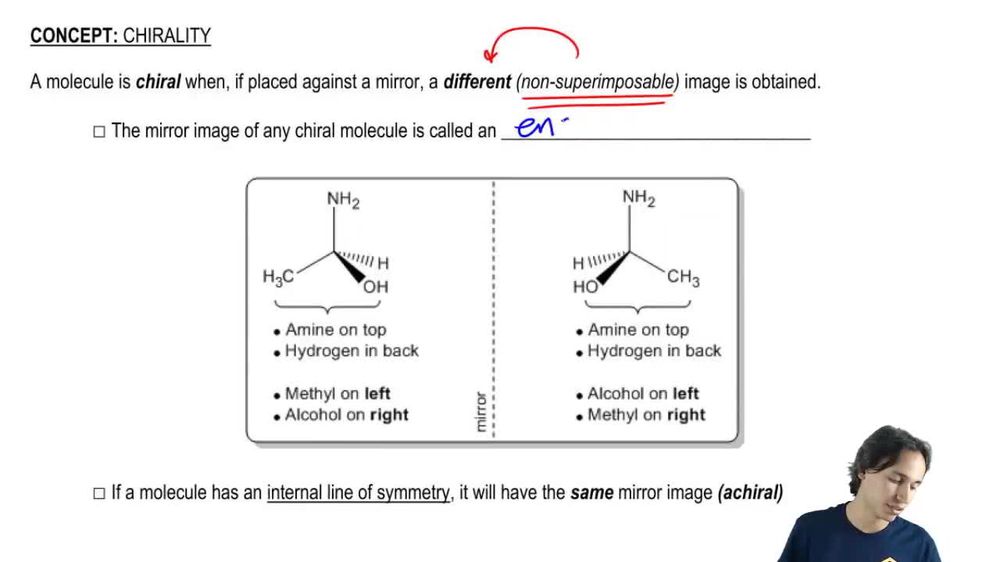
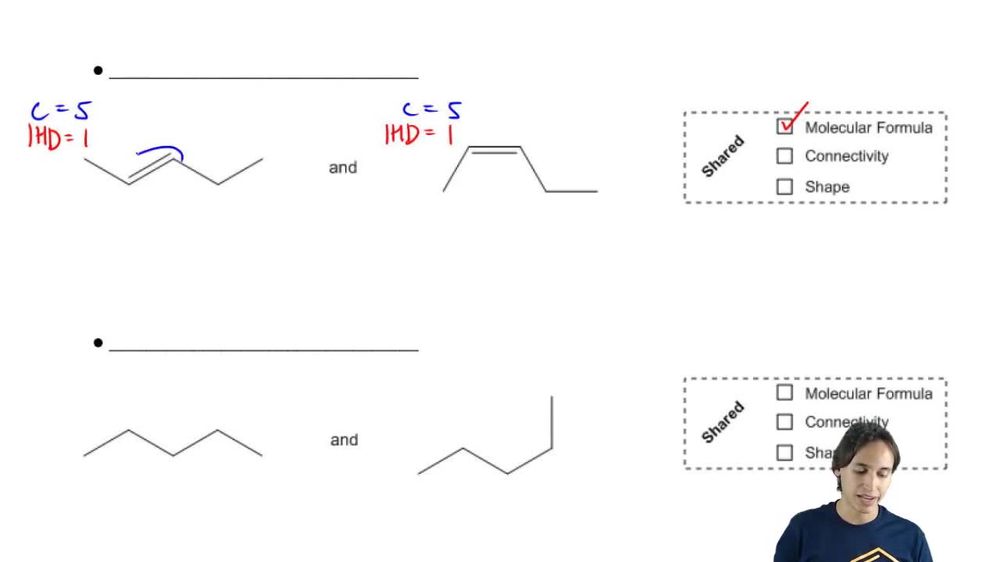
Stereoisomerism refers to the phenomenon where compounds have the same molecular formula and connectivity of atoms but differ in the spatial arrangement of their atoms. This can lead to different physical and chemical properties. The two main types of stereoisomers are enantiomers, which are non-superimposable mirror images, and diastereomers, which are not mirror images of each other.
Chirality is a property of a molecule that makes it non-superimposable on its mirror image, often due to the presence of a chiral center, typically a carbon atom bonded to four different substituents. In the case of 2-bromo-4-chlorohexane, the presence of chiral centers can lead to the formation of multiple stereoisomers, which are crucial for understanding the compound's behavior in biological systems.
Drawing stereoisomers involves representing the different spatial arrangements of atoms in a molecule. For 2-bromo-4-chlorohexane, one must identify the chiral centers and then systematically create all possible configurations (R/S notation) for each center. This process helps visualize the distinct stereoisomers and understand their potential interactions and reactivity.