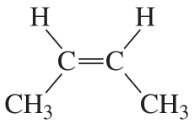
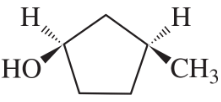
Draw a diastereomer for each of the following: c. d.
Verified step by step guidance
1
Step 1: Understand the concept of diastereomers. Diastereomers are stereoisomers that are not mirror images of each other. They differ in the spatial arrangement of atoms but are not enantiomers.
Step 2: Analyze the first structure (c). The molecule contains a double bond (C=C) with two hydrogen atoms and two methyl groups (CH₃) attached. This is an example of geometric isomerism (cis-trans isomerism). To draw a diastereomer, change the spatial arrangement of the substituents around the double bond. For example, if the given structure is cis (both CH₃ groups on the same side), draw the trans isomer (CH₃ groups on opposite sides).
Step 3: Analyze the second structure (d). The molecule is a cyclic compound with two stereocenters (chiral centers). To draw a diastereomer, invert the configuration at one of the stereocenters while keeping the other unchanged. For example, if the hydroxyl group (OH) and hydrogen (H) are in a specific orientation, flip the orientation of one group while keeping the other intact.
Step 4: Use wedge and dash notation to represent the stereochemistry clearly. Wedges indicate bonds coming out of the plane, and dashes indicate bonds going into the plane. Ensure the diastereomer is not a mirror image of the original structure.
Step 5: Verify the diastereomer by checking that it is not superimposable on the original structure and is not its enantiomer. Confirm that the spatial arrangement of atoms satisfies the definition of diastereomers.
Verified video answer for a similar problem:
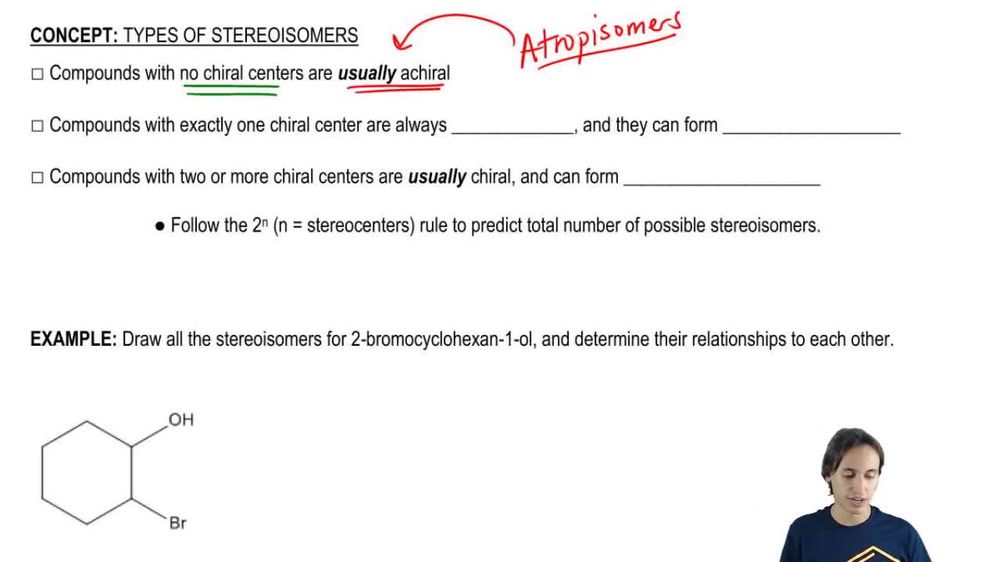
This video solution was recommended by our tutors as helpful for the problem above
Video duration:
5m
Play a video:
0 Comments
Key Concepts
Here are the essential concepts you must grasp in order to answer the question correctly.
Diastereomers
Diastereomers are stereoisomers that are not mirror images of each other. They occur when a molecule has multiple chiral centers, leading to different spatial arrangements of atoms. Unlike enantiomers, which have identical physical properties except for their interaction with polarized light, diastereomers can have significantly different chemical and physical properties, making their identification and differentiation crucial in organic chemistry.
Using chiral centers to predict types of stereoisomers.
Chirality
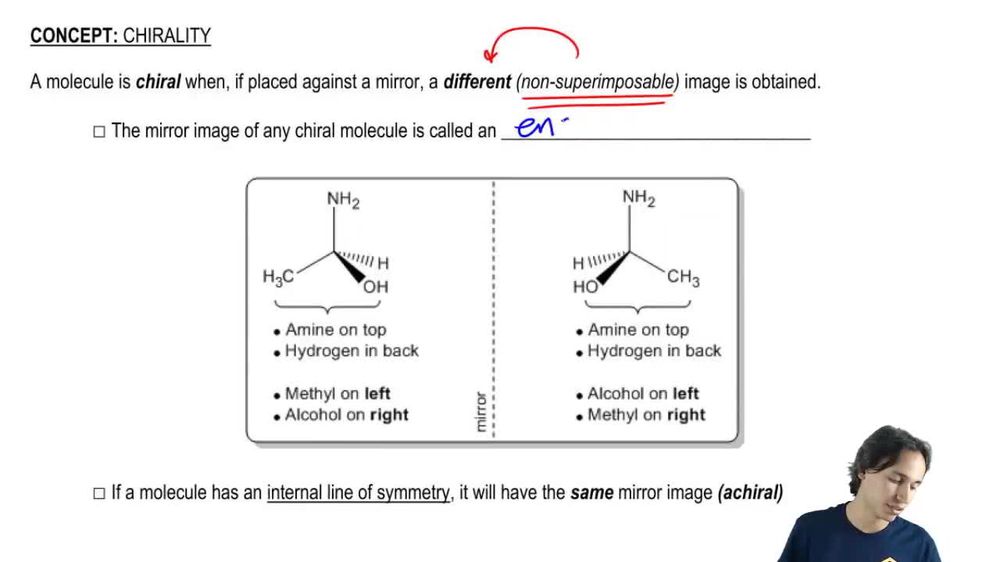
Chirality refers to the geometric property of a molecule that makes it non-superimposable on its mirror image. A chiral molecule typically contains at least one carbon atom bonded to four different substituents, creating two distinct configurations known as enantiomers. Understanding chirality is essential for recognizing how diastereomers are formed and how they relate to the overall stereochemistry of a compound.
Stereochemistry is the study of the spatial arrangement of atoms in molecules and how this arrangement affects their chemical behavior. It encompasses concepts such as chirality, diastereomers, and geometric isomerism. A solid grasp of stereochemistry is vital for drawing and understanding diastereomers, as it allows chemists to visualize and predict the properties and reactivity of different isomeric forms.