How many alkyl halides are obtained from monochlorination of the alkanes in Problem 4 if stereoisomers are included? e.
Verified step by step guidance
1
Step 1: Identify the structure of the given alkane. The image shows methylcyclopentane, which consists of a cyclopentane ring with a single methyl group attached to one of the carbons.
Step 2: Determine the possible sites for monochlorination. Monochlorination involves replacing one hydrogen atom with a chlorine atom. In methylcyclopentane, there are hydrogens on the ring carbons and the methyl group that can be substituted.
Step 3: Analyze the symmetry of the molecule. Methylcyclopentane is not symmetric due to the methyl group, meaning that hydrogens on different carbons may lead to distinct products.
Step 4: Consider stereoisomers. If a chlorine atom is added to a chiral center (a carbon with four different groups), stereoisomers (R and S configurations) will be formed. Evaluate which carbons in the molecule are chiral after chlorination.
Step 5: Count the unique alkyl halides formed. Include all possible structural isomers and stereoisomers resulting from monochlorination at each unique position in the molecule.
Verified video answer for a similar problem:
This video solution was recommended by our tutors as helpful for the problem above
Video duration:
2m
Play a video:
0 Comments
Key Concepts
Here are the essential concepts you must grasp in order to answer the question correctly.
Monochlorination
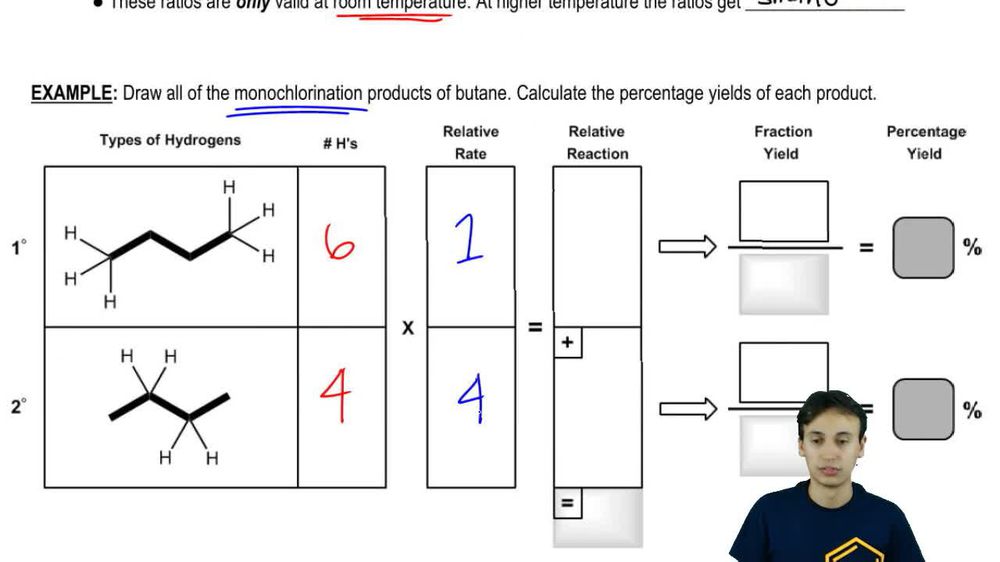
Monochlorination is a chemical reaction where one chlorine atom replaces a hydrogen atom in an alkane. This process typically occurs through a free radical mechanism, involving initiation, propagation, and termination steps. The result is the formation of alkyl halides, which can vary based on the position of substitution and the structure of the alkane.
Draw all of the monochlorination products and calculate percentage yields.
Stereoisomers
Stereoisomers are compounds that have the same molecular formula and connectivity of atoms but differ in the spatial arrangement of their atoms. In the context of alkyl halides, stereoisomers can arise when the chlorination occurs at a chiral center, leading to different configurations (e.g., R and S forms) that must be considered when counting the total number of products.
Alkyl halides are organic compounds derived from alkanes by replacing one or more hydrogen atoms with halogen atoms (such as chlorine, bromine, or iodine). The properties and reactivity of alkyl halides depend on the type of halogen and the structure of the alkyl group, influencing their behavior in further chemical reactions, including substitution and elimination.

 2:53 minutes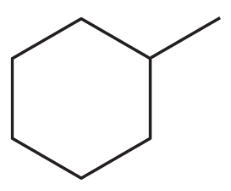
 Verified step by step guidance
 04:37
04:37