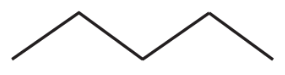
How many alkyl halides are obtained from monochlorination of the alkanes in Problem 4 if stereoisomers are included? a.
Verified step by step guidance
1
Step 1: Identify the structure of the alkane provided in the image. The structure is a straight-chain alkane with five carbon atoms, known as pentane.
Step 2: Determine the possible positions for monochlorination. Chlorination can occur at any hydrogen atom attached to the carbon atoms in the pentane molecule. These positions include the primary hydrogens (on the terminal carbons) and the secondary hydrogens (on the internal carbons).
Step 3: Consider the symmetry of the molecule. Pentane is symmetrical, so chlorination at equivalent positions will yield identical products. For example, chlorination at either terminal carbon will produce the same alkyl halide.
Step 4: Account for stereoisomers. If chlorination occurs at a chiral center (a carbon atom bonded to four different groups), stereoisomers (R and S configurations) must be considered. In this case, secondary carbons in pentane can become chiral after chlorination.
Step 5: Count the unique alkyl halides formed, including stereoisomers. Evaluate each unique position for chlorination and determine if stereoisomers are possible at that position. Sum the total number of distinct alkyl halides.
Verified video answer for a similar problem:
This video solution was recommended by our tutors as helpful for the problem above
Video duration:
2m
Play a video:
0 Comments
Key Concepts
Here are the essential concepts you must grasp in order to answer the question correctly.
Alkyl Halides
Alkyl halides are organic compounds derived from alkanes by replacing one or more hydrogen atoms with halogen atoms (such as chlorine, bromine, or iodine). They can be classified as primary, secondary, or tertiary based on the carbon atom to which the halogen is attached. Understanding the structure and classification of alkyl halides is crucial for predicting the products of reactions like halogenation.
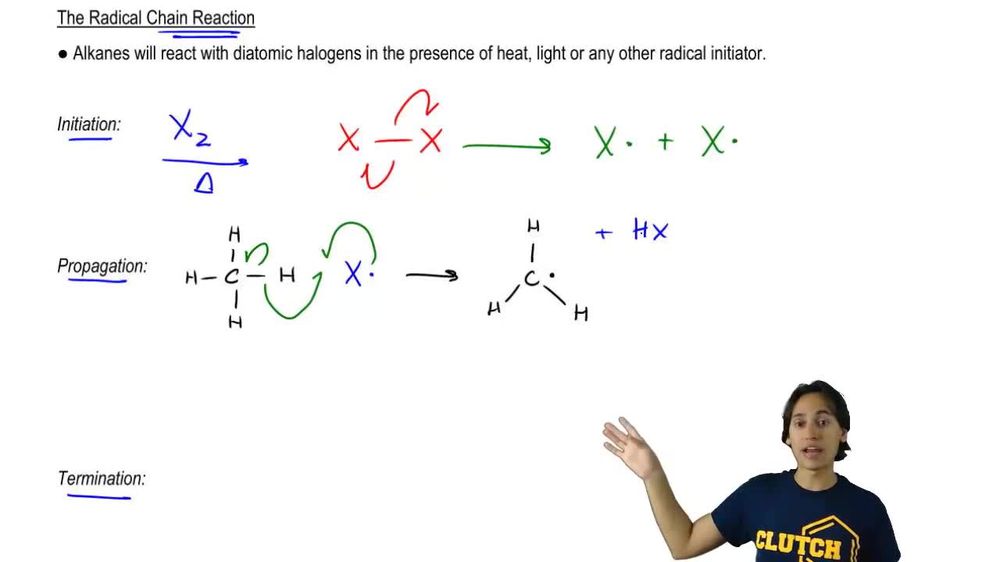
Free radical halogenation is a reaction mechanism where alkanes react with halogens (like Cl2 or Br2) in the presence of heat or light to form alkyl halides. This process involves the formation of free radicals, which are highly reactive species with unpaired electrons. The mechanism includes initiation, propagation, and termination steps, and it is essential to understand this to predict the products and their stereochemistry.
Stereoisomerism occurs when compounds have the same molecular formula and connectivity but differ in the spatial arrangement of atoms. In the context of alkyl halides, monochlorination can lead to the formation of stereoisomers if the carbon atom where the halogen is added is chiral. Recognizing the potential for stereoisomers is important for determining the total number of distinct products formed during the halogenation process.