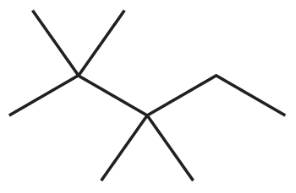
How many alkyl chlorides are obtained from monochlorination of the following alkanes? Disregard stereoisomers. h.
Verified step by step guidance
1
Step 1: Identify the structure of the given alkane. The image shows 2-methylbutane, which is a branched alkane with five carbon atoms.
Step 2: Determine the types of hydrogen atoms present in the molecule. In 2-methylbutane, there are primary, secondary, and tertiary hydrogens. Primary hydrogens are attached to primary carbons, secondary hydrogens are attached to secondary carbons, and tertiary hydrogens are attached to tertiary carbons.
Step 3: Analyze the possible sites for monochlorination. Monochlorination replaces one hydrogen atom with a chlorine atom. Each unique type of hydrogen atom leads to a different alkyl chloride product.
Step 4: Count the unique positions for hydrogen replacement. In 2-methylbutane, there are three unique positions: (1) the primary hydrogens on the terminal carbons, (2) the secondary hydrogens on the carbon adjacent to the methyl group, and (3) the tertiary hydrogen on the central carbon.
Step 5: Conclude the number of alkyl chlorides formed. Since stereoisomers are disregarded, each unique position leads to one distinct alkyl chloride. Therefore, the total number of alkyl chlorides is equal to the number of unique positions identified in Step 4.
Verified video answer for a similar problem:
This video solution was recommended by our tutors as helpful for the problem above
Video duration:
4m
Play a video:
0 Comments
Key Concepts
Here are the essential concepts you must grasp in order to answer the question correctly.
Free Radical Halogenation
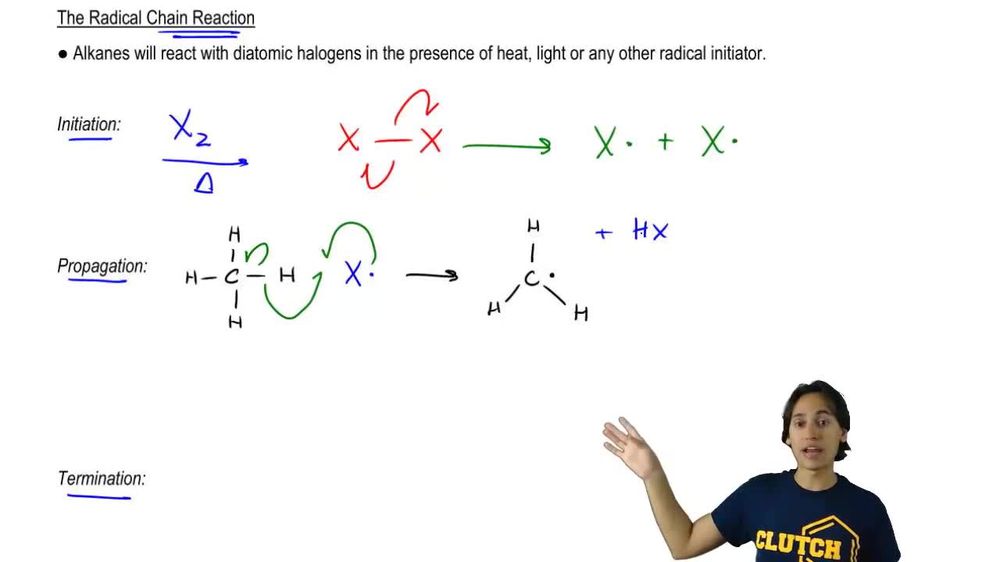
Free radical halogenation is a reaction mechanism where alkanes react with halogens (like chlorine) to form alkyl halides. This process involves the generation of free radicals through the homolytic cleavage of the halogen bond, followed by a series of propagation steps that lead to the substitution of hydrogen atoms with halogen atoms. Understanding this mechanism is crucial for predicting the products of monochlorination.
Monochlorination refers to the substitution of a single hydrogen atom in an alkane with a chlorine atom. This process can yield multiple products depending on the number of unique hydrogen atoms available for substitution. The resulting alkyl chlorides can vary based on the structure of the alkane and the position of the chlorine substitution, making it essential to analyze the alkane's structure to determine the number of distinct products.
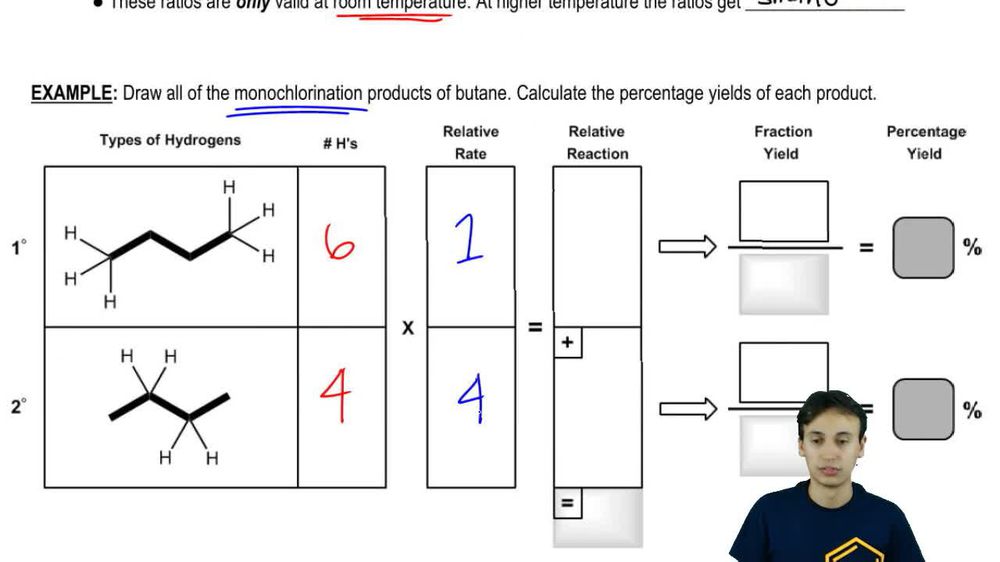
Draw all of the monochlorination products and calculate percentage yields.
Alkyl Chlorides
Alkyl chlorides are organic compounds formed when one or more hydrogen atoms in an alkane are replaced by chlorine atoms. They are classified based on the carbon atom to which the chlorine is attached, such as primary, secondary, or tertiary alkyl chlorides. The type of alkyl chloride produced during monochlorination is influenced by the stability of the resulting free radicals, which affects the likelihood of each substitution occurring.