Draw structures for the following: e. two achiral stereoisomers of 3,4,5-trimethylheptane
Verified step by step guidance
1
Step 1: Understand the term 'achiral stereoisomers'. Achiral molecules are those that have a superimposable mirror image, meaning they do not have a chiral center. Stereoisomers are molecules that have the same molecular formula and sequence of bonded atoms, but differ in the three-dimensional orientations of their atoms in space.
Step 2: Draw the structure of 3,4,5-trimethylheptane. This is a heptane molecule (7 carbon atoms in a straight chain) with methyl groups (CH3) attached to the 3rd, 4th, and 5th carbon atoms.
Step 3: Identify the chiral centers. In this case, there are no chiral centers in 3,4,5-trimethylheptane because none of the carbon atoms have four different groups attached to them.
Step 4: Draw two different stereoisomers. Since the molecule is achiral, the stereoisomers will be 'conformational isomers', which differ by rotation around a single bond. For example, you could draw one isomer with all three methyl groups on the same side of the molecule (all 'up' or all 'down'), and another isomer with one methyl group on one side and two on the other.
Step 5: Verify that the two structures you have drawn are indeed different, and that they are both achiral. They should be mirror images of each other that can be superimposed, confirming that they are achiral.
Verified video answer for a similar problem:
This video solution was recommended by our tutors as helpful for the problem above
Video duration:
4m
Play a video:
0 Comments
Key Concepts
Here are the essential concepts you must grasp in order to answer the question correctly.
Stereoisomerism
Stereoisomerism refers to the phenomenon where compounds have the same molecular formula and connectivity of atoms but differ in the spatial arrangement of those atoms. This can lead to different physical and chemical properties. In organic chemistry, stereoisomers can be classified into enantiomers and diastereomers, with the former being non-superimposable mirror images and the latter not being mirror images.
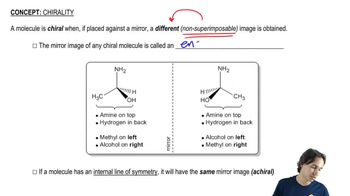
Chirality is a property of a molecule that makes it non-superimposable on its mirror image, much like left and right hands. A chiral molecule typically has a carbon atom bonded to four different substituents, creating two distinct enantiomers. In contrast, achiral molecules possess a plane of symmetry and can be superimposed on their mirror images, which is crucial for understanding the types of stereoisomers present in a compound.
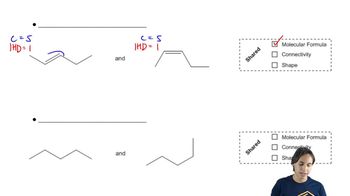
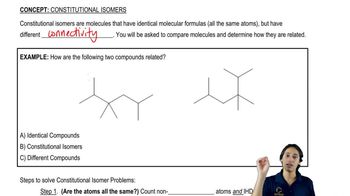
Structural isomers are compounds that share the same molecular formula but differ in the connectivity of their atoms. This can include variations in the arrangement of carbon chains or functional groups. In the case of 3,4,5-trimethylheptane, identifying achiral stereoisomers involves recognizing different structural arrangements that do not create chirality, allowing for the drawing of distinct yet non-chiral forms.