Classify the following objects and molecules as chiral or achiral. (e)
Verified step by step guidance
1
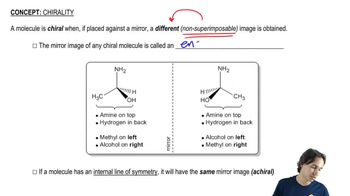
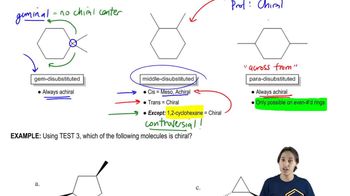
Step 1: Understand the concept of chirality. A molecule is chiral if it is not superimposable on its mirror image, meaning it lacks an internal plane of symmetry. Achiral molecules, on the other hand, have symmetry and are superimposable on their mirror images.
Step 2: Analyze the structure of the molecule provided. The molecule is a benzene ring substituted with three nitro groups (-NO2) at positions 1, 3, and 5.
Step 3: Check for symmetry in the molecule. The substituents are arranged symmetrically around the benzene ring, with identical groups (-NO2) at positions 1, 3, and 5. This indicates the presence of a plane of symmetry.
Step 4: Determine if the molecule can be superimposed on its mirror image. Due to the symmetrical arrangement of the substituents, the molecule is superimposable on its mirror image.
Step 5: Conclude the classification. Based on the analysis, the molecule is achiral because it has a plane of symmetry and is superimposable on its mirror image.
Verified video answer for a similar problem:
This video solution was recommended by our tutors as helpful for the problem above
Play a video:
0 Comments
Key Concepts
Here are the essential concepts you must grasp in order to answer the question correctly.
Chirality
Chirality refers to the geometric property of a molecule that makes it non-superimposable on its mirror image. A chiral molecule typically has a carbon atom bonded to four different substituents, resulting in two distinct forms known as enantiomers. This property is crucial in organic chemistry, especially in the context of pharmaceuticals, where different enantiomers can have different biological activities.
Achirality describes molecules that are superimposable on their mirror images, meaning they do not have a chiral center. These molecules often possess a plane of symmetry or are symmetrical in structure. Understanding achirality is important for distinguishing between chiral and achiral substances, which can affect their chemical behavior and interactions.
Stereoisomerism is a form of isomerism where molecules have the same molecular formula and connectivity of atoms but differ in the spatial arrangement of their atoms. This includes both enantiomers (chiral) and diastereomers (not mirror images). Recognizing stereoisomers is essential for classifying molecules as chiral or achiral, as the arrangement of atoms can significantly influence their properties and reactivity.