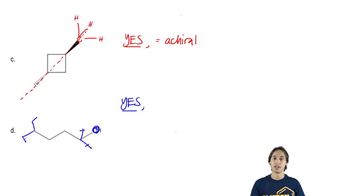
Identify all planes of symmetry in the following molecules/conformations, if any. (d)
Verified step by step guidance
1
Step 1: Analyze the molecular structure provided. The molecule is a substituted cyclohexane in a chair conformation with a CH₃ group and a Br atom attached to the ring. The remaining substituents are hydrogen atoms.
Step 2: Recall the concept of a plane of symmetry. A plane of symmetry divides a molecule into two mirror-image halves. For cyclohexane in the chair conformation, symmetry depends on the arrangement of substituents.
Step 3: Examine the positions of the substituents. The CH₃ group is in an axial position, and the Br atom is in an equatorial position. The hydrogen atoms occupy the remaining axial and equatorial positions.
Step 4: Determine if a plane of symmetry exists. A plane of symmetry would require the substituents on one side of the molecule to mirror those on the opposite side. In this case, the CH₃ and Br groups disrupt symmetry, as they are different and positioned asymmetrically.
Step 5: Conclude that the molecule does not have a plane of symmetry due to the asymmetrical arrangement of the CH₃ and Br substituents in the chair conformation.
Verified video answer for a similar problem:
This video solution was recommended by our tutors as helpful for the problem above
Play a video:
0 Comments
Key Concepts
Here are the essential concepts you must grasp in order to answer the question correctly.
Planes of Symmetry
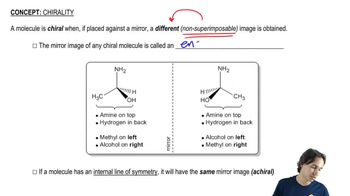
A plane of symmetry is an imaginary plane that divides a molecule into two mirror-image halves. Identifying these planes is crucial for determining the symmetry of a molecule, which can influence its physical and chemical properties. Molecules with planes of symmetry are often achiral, meaning they do not have non-superimposable mirror images.
Chirality refers to the property of a molecule that makes it non-superimposable on its mirror image. A chiral molecule lacks a plane of symmetry and typically has at least one chiral center, often a carbon atom bonded to four different substituents. Understanding chirality is essential for predicting the behavior of molecules in biological systems and their interactions with polarized light.
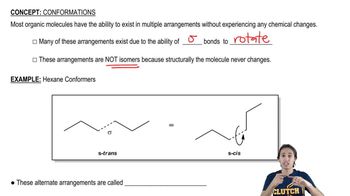
Molecular conformations are the different spatial arrangements of atoms in a molecule that result from rotation around single bonds. These conformations can affect the overall symmetry and chirality of the molecule. Analyzing conformations is important for understanding how molecular shape influences reactivity and interactions in organic chemistry.