Draw the product or products that will be obtained from the reaction of cis-2-butene and trans-2-butene with each of the following reagents. If a product can exist as stereoisomers, show which stereoisomers are formed. 1. HCl
Verified step by step guidance
1
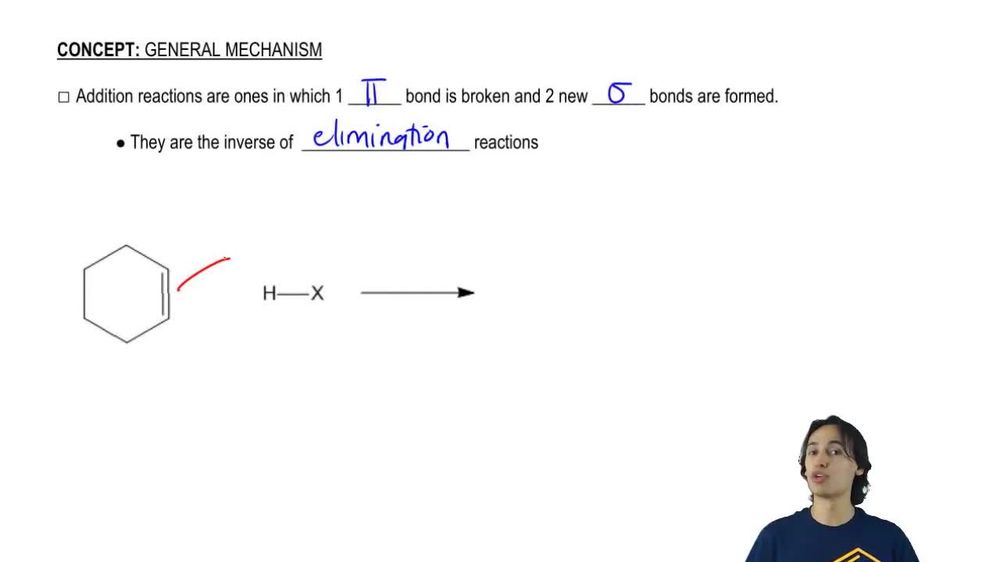
Identify the type of reaction: The reaction of an alkene (cis-2-butene or trans-2-butene) with HCl is an electrophilic addition reaction. The π-bond in the alkene will react with HCl, leading to the formation of a carbocation intermediate and subsequent addition of the chloride ion.
Determine the regioselectivity: Since both cis-2-butene and trans-2-butene are symmetrical alkenes, the addition of HCl will not result in regioisomers. The hydrogen atom from HCl will add to one of the carbons in the double bond, and the chloride ion will add to the other carbon.
Consider stereochemistry: For cis-2-butene, the addition of HCl can lead to the formation of a single product because the molecule is symmetrical. For trans-2-butene, the same product will form, but the stereochemistry of the starting material does not affect the product in this case because the product is achiral.
Draw the product: The product for both cis-2-butene and trans-2-butene reacting with HCl will be 2-chlorobutane. Since the product does not have a stereogenic center, no stereoisomers are formed.
Verify the mechanism: Ensure that the mechanism follows the correct steps: (1) Protonation of the double bond to form a carbocation intermediate, and (2) nucleophilic attack by the chloride ion to form the final product.
Verified video answer for a similar problem:
This video solution was recommended by our tutors as helpful for the problem above
Video duration:
11m
Play a video:
0 Comments
Key Concepts
Here are the essential concepts you must grasp in order to answer the question correctly.
Alkenes and Their Reactions
Alkenes are hydrocarbons that contain at least one carbon-carbon double bond. They undergo various reactions, including electrophilic addition, where reagents add across the double bond. Understanding the structure of alkenes, such as cis and trans isomers, is crucial for predicting the products formed during these reactions.
The electrophilic addition mechanism involves the attack of an electrophile on the electron-rich double bond of an alkene. In the case of HCl, the hydrogen atom acts as the electrophile, leading to the formation of a carbocation intermediate. The stability of this intermediate influences the final product distribution, including the formation of stereoisomers.
Stereochemistry is the study of the spatial arrangement of atoms in molecules and how this affects their chemical behavior. When alkenes react, they can form stereoisomers, which are compounds with the same molecular formula but different spatial orientations. Recognizing the potential for cis and trans isomers in the products is essential for accurately representing the outcome of the reaction.

 11:05 minutes
 Verified step by step guidance
 2:09
2:09