a. What product is obtained from the reaction of HCl with 1-butene? With 2-butene? b. Which of the two reactions has the greater free energy of activation? c. Which compound reacts more rapidly with HCl: (Z)-2-butene or (E)-2-butene?
Verified step by step guidance
1
Step 1: Analyze the reaction of HCl with 1-butene. HCl adds across the double bond in an electrophilic addition reaction. The hydrogen (H⁺) from HCl will attach to the carbon with more hydrogens (Markovnikov's rule), and the chloride ion (Cl⁻) will attach to the other carbon. Write the mechanism for this reaction, showing the formation of a carbocation intermediate and the final product.
Step 2: Analyze the reaction of HCl with 2-butene. Similar to 1-butene, HCl will add across the double bond. Depending on whether the double bond is in the (Z)- or (E)-configuration, the product will be determined by the regioselectivity and stereochemistry of the reaction. Write the mechanism for this reaction, showing the formation of the carbocation intermediate and the final product.
Step 3: Compare the free energy of activation for the two reactions. The free energy of activation depends on the stability of the carbocation intermediate formed during the reaction. Explain how the stability of the carbocation (primary vs. secondary) affects the free energy of activation for 1-butene and 2-butene.
Step 4: Compare the reactivity of (Z)-2-butene and (E)-2-butene with HCl. The steric hindrance in the (Z)-isomer, where substituents are on the same side of the double bond, can slow down the reaction compared to the (E)-isomer, where substituents are on opposite sides. Discuss how steric effects influence the rate of reaction.
Step 5: Summarize the key concepts: Markovnikov's rule for regioselectivity, carbocation stability affecting free energy of activation, and steric hindrance influencing reaction rates. Use these principles to explain the differences in products, activation energy, and reaction rates for the given compounds.
Verified video answer for a similar problem:
This video solution was recommended by our tutors as helpful for the problem above
Video duration:
5m
Play a video:
0 Comments
Key Concepts
Here are the essential concepts you must grasp in order to answer the question correctly.
Electrophilic Addition Reactions
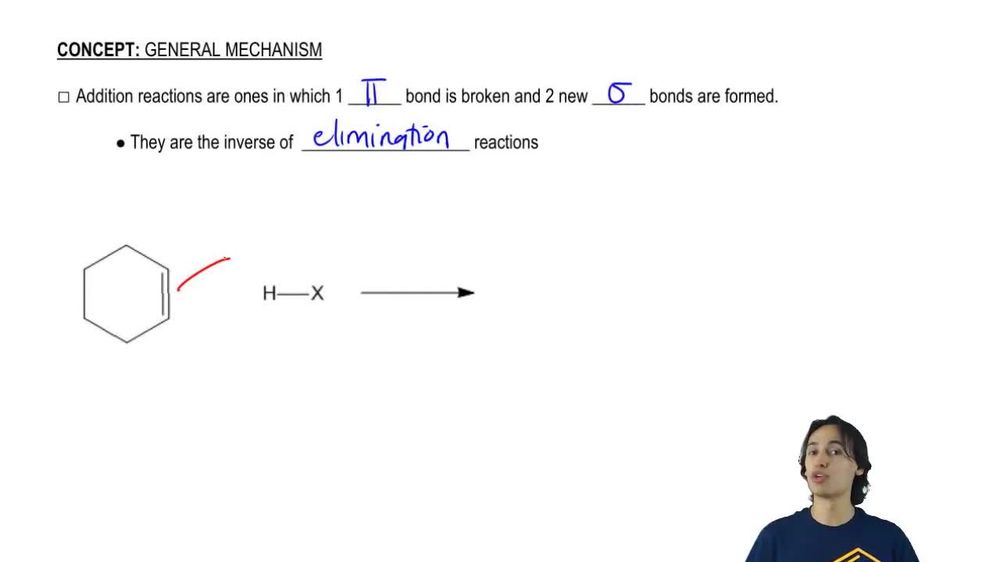
Electrophilic addition reactions involve the addition of an electrophile to a nucleophile, typically seen in alkenes. In the case of 1-butene and 2-butene reacting with HCl, the double bond acts as a nucleophile, attacking the electrophilic hydrogen in HCl, leading to the formation of alkyl halides. The regioselectivity of the reaction is influenced by the stability of the carbocation intermediate formed during the process.
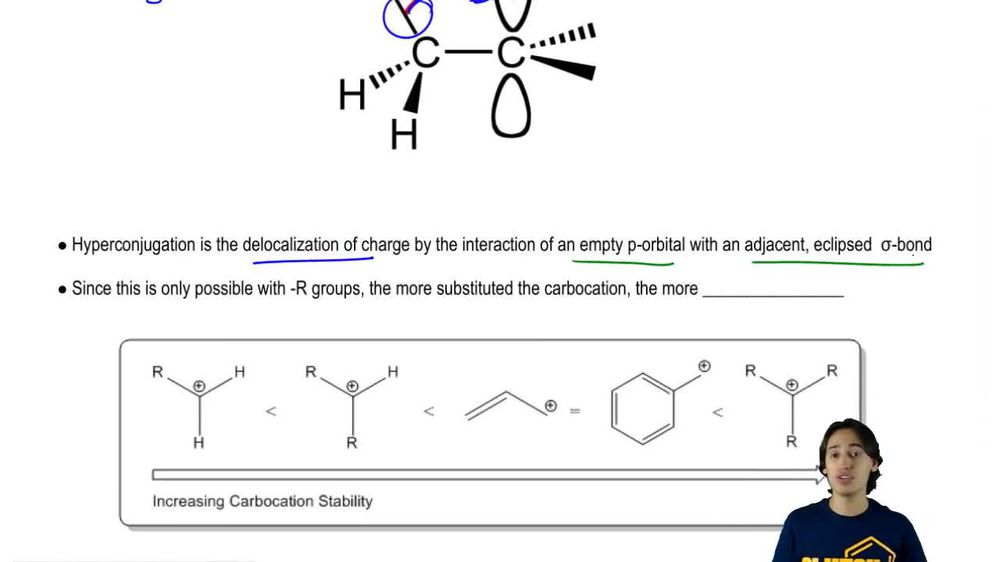
Carbocation stability is a key factor in determining the outcome of electrophilic addition reactions. Tertiary carbocations are more stable than secondary, which are more stable than primary due to hyperconjugation and inductive effects. In the context of the question, the stability of the carbocation formed from 1-butene versus 2-butene will influence the rate of reaction and the product distribution.
Stereochemistry plays a significant role in the reactivity of alkenes, particularly in the case of (Z)-2-butene and (E)-2-butene. The spatial arrangement of substituents around the double bond can affect the approach of the electrophile, leading to differences in reaction rates. Generally, steric hindrance and the orientation of substituents can influence how quickly each is able to react with HCl.

 5:12 minutes
 Verified step by step guidance
 05:39
05:39