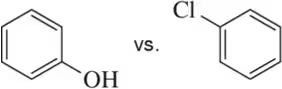
In each pair, (i) choose the compound that is most soluble in water. (ii) Within each pair, which is most soluble in nonpolar solvents? (a)
Verified step by step guidance
1
Step 1: Analyze the structures of the two compounds. Compound (I) is benzene-1,2-diol (catechol), which contains two hydroxyl (-OH) groups attached to the benzene ring. Compound (II) is methylbenzene (toluene), which contains a methyl (-CH3) group attached to the benzene ring.
Step 2: Consider the solubility in water. Water is a polar solvent, and compounds with polar functional groups (such as hydroxyl groups) are more soluble in water due to hydrogen bonding. Compound (I) has two hydroxyl groups, which can form hydrogen bonds with water molecules, making it more soluble in water compared to Compound (II), which has a nonpolar methyl group.
Step 3: Consider the solubility in nonpolar solvents. Nonpolar solvents dissolve nonpolar compounds better due to the principle of 'like dissolves like.' Compound (II) has a nonpolar methyl group and a benzene ring, making it more soluble in nonpolar solvents compared to Compound (I), which has polar hydroxyl groups.
Step 4: Summarize the findings. Compound (I) is most soluble in water due to its polar hydroxyl groups, while Compound (II) is most soluble in nonpolar solvents due to its nonpolar methyl group and benzene ring.
Step 5: To further understand, recall that solubility depends on the ability of the solvent to interact with the solute. Polar solvents like water interact strongly with polar groups, while nonpolar solvents interact with nonpolar groups through dispersion forces.
Verified video answer for a similar problem:
This video solution was recommended by our tutors as helpful for the problem above
Video duration:
2m
Play a video:
0 Comments
Key Concepts
Here are the essential concepts you must grasp in order to answer the question correctly.
Polarity and Solubility
Polarity refers to the distribution of electrical charge over the atoms in a molecule. Polar molecules, which have a significant difference in electronegativity between atoms, tend to dissolve well in polar solvents like water. In contrast, nonpolar molecules, which have an even distribution of charge, are more soluble in nonpolar solvents, such as hydrocarbons.
The hydroxyl group (-OH) is a functional group that significantly increases a compound's polarity due to its ability to form hydrogen bonds with water molecules. This property enhances the solubility of compounds containing hydroxyl groups in polar solvents, making phenol (compound I) more soluble in water compared to toluene (compound II), which lacks such polar functional groups.
Hydrocarbons are organic compounds consisting entirely of hydrogen and carbon. Toluene, which is a hydrocarbon with a methyl group, is nonpolar and thus more soluble in nonpolar solvents. The structure of hydrocarbons, particularly their lack of polar functional groups, dictates their solubility behavior in different solvent environments.