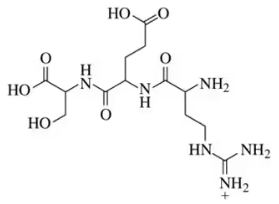
Classify the following molecules as hydrophilic, hydrophobic, lipophilic, or lipophobic. Each molecule should have two classifications. (b)
Verified step by step guidance
1
Analyze the molecular structure provided in the image. Identify functional groups such as hydroxyl (-OH), carboxyl (-COOH), amine (-NH2), and any charged groups.
Determine the hydrophilic nature of the molecule by assessing the presence of polar functional groups (e.g., hydroxyl, carboxyl, and amine groups) and charged regions. Polar and charged groups interact well with water, making the molecule hydrophilic.
Evaluate the hydrophobic nature of the molecule by identifying any nonpolar regions, such as hydrocarbon chains or aromatic rings. Nonpolar regions repel water, contributing to hydrophobicity.
Assess the lipophilic nature of the molecule by considering whether the molecule has nonpolar regions that can dissolve in lipids or fats. Lipophilic molecules typically have significant hydrocarbon content.
Determine the lipophobic nature of the molecule by analyzing the extent of polar and charged groups that prevent the molecule from dissolving in lipids or fats. Molecules with many polar groups are often lipophobic.
Verified video answer for a similar problem:
This video solution was recommended by our tutors as helpful for the problem above
Play a video:
0 Comments
Key Concepts
Here are the essential concepts you must grasp in order to answer the question correctly.
Hydrophilicity and Hydrophobicity
Hydrophilicity refers to the tendency of a molecule to interact favorably with water, often due to the presence of polar functional groups like hydroxyl (-OH) or amino (-NH2) groups. Conversely, hydrophobic molecules repel water and are typically nonpolar, lacking such functional groups. Understanding these properties is crucial for classifying molecules based on their solubility in water.
Lipophilicity describes a molecule's affinity for lipids or fats, often associated with nonpolar characteristics that allow it to dissolve in organic solvents. Lipophobicity, on the other hand, indicates a molecule's aversion to lipids, typically due to polar or charged functional groups. These classifications are important for understanding how molecules behave in biological systems, particularly in membrane interactions.
Functional Groups and Their Effects
Functional groups are specific groups of atoms within molecules that determine their chemical reactivity and properties. For example, hydroxyl groups contribute to hydrophilicity, while amine groups can impart both hydrophilic and lipophilic characteristics. Identifying these groups in a molecule helps predict its behavior in aqueous or lipid environments, which is essential for the classification task at hand.