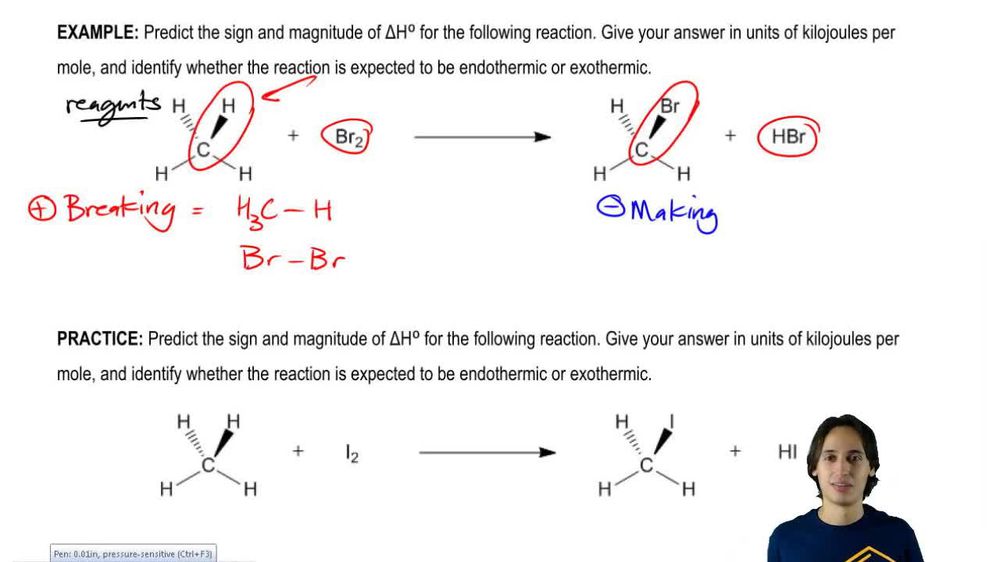
a. Using the BDEs in Table 4-2 (page 167), compute the value of ΔH° for each step in the iodination of methane. b. Compute the overall value of ΔH° for iodination.
Verified step by step guidance
1
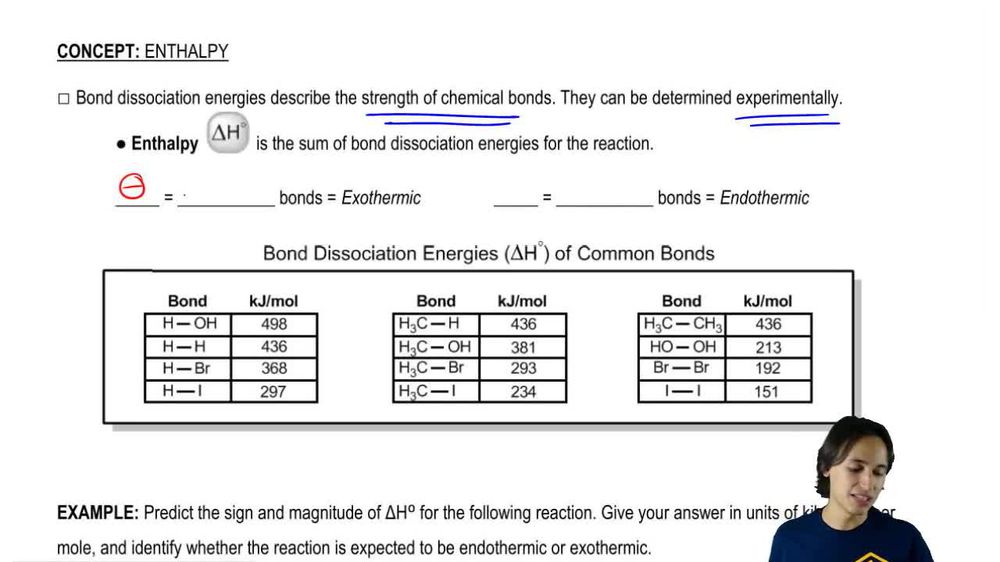
Step 1: Understand the problem. The iodination of methane involves breaking and forming bonds. To compute ΔH° for each step, you need to use bond dissociation energies (BDEs) provided in [TABLE 4-2]. BDEs represent the energy required to break a bond in a molecule. The overall ΔH° is the sum of the ΔH° values for all steps in the reaction.
Step 2: Write the chemical equation for the iodination of methane. The reaction involves CH₄ (methane) reacting with I₂ (iodine) to form CH₃I (methyl iodide) and HI (hydrogen iodide). Break down the reaction into individual steps: (1) breaking the C-H bond in CH₄, (2) breaking the I-I bond in I₂, (3) forming the C-I bond in CH₃I, and (4) forming the H-I bond in HI.
Step 3: Use the BDEs from [TABLE 4-2] to calculate ΔH° for each step. For example: (1) Find the BDE for the C-H bond in CH₄ and use it to calculate the energy required to break this bond. (2) Find the BDE for the I-I bond in I₂ and calculate the energy required to break this bond. (3) Find the BDE for the C-I bond in CH₃I and calculate the energy released when this bond forms. (4) Find the BDE for the H-I bond in HI and calculate the energy released when this bond forms.
Step 4: Compute the ΔH° for each step using the formula ΔH° = Σ(BDE of bonds broken) - Σ(BDE of bonds formed). For each step, subtract the energy released (bonds formed) from the energy required (bonds broken). Ensure you use the correct BDE values from the table.
Step 5: Add the ΔH° values for all steps to compute the overall ΔH° for the iodination of methane. This sum represents the net energy change for the reaction. If the value is negative, the reaction is exothermic; if positive, the reaction is endothermic.
Verified video answer for a similar problem:
This video solution was recommended by our tutors as helpful for the problem above
Video duration:
2m
Play a video:
0 Comments
Key Concepts
Here are the essential concepts you must grasp in order to answer the question correctly.
Bond Dissociation Energy (BDE)
Bond Dissociation Energy (BDE) is the energy required to break a specific bond in a molecule, resulting in the formation of free radicals or atoms. It is a crucial concept in thermochemistry, as it helps predict the stability of molecules and the energy changes during chemical reactions. In the context of iodination of methane, BDE values are used to calculate the enthalpy changes associated with bond breaking and forming.
How to calculate enthalpy using bond dissociation energies.
Enthalpy Change (ΔH°)
Enthalpy change (ΔH°) refers to the heat content change of a system at constant pressure during a chemical reaction. It can be calculated by summing the BDEs of bonds broken and formed in the reaction. Understanding ΔH° is essential for evaluating the thermodynamic favorability of a reaction, such as the iodination of methane, where the overall enthalpy change indicates whether the reaction is exothermic or endothermic.
Iodination of methane is a radical substitution reaction where iodine replaces one of the hydrogen atoms in methane (CH₄). This process typically involves the formation of methyl radicals and iodine radicals, leading to the generation of iodomethane (CH₃I). Analyzing the enthalpy changes during this reaction requires an understanding of the steps involved, including initiation, propagation, and termination, which are influenced by the BDEs of the involved bonds.