Use bond-dissociation enthalpies (Table 4-2, p. 167) to calculate values of ΔH° for the following reactions. b. CH3CH2Cl + HI → CH3CH2I + HCl
Verified step by step guidance
1
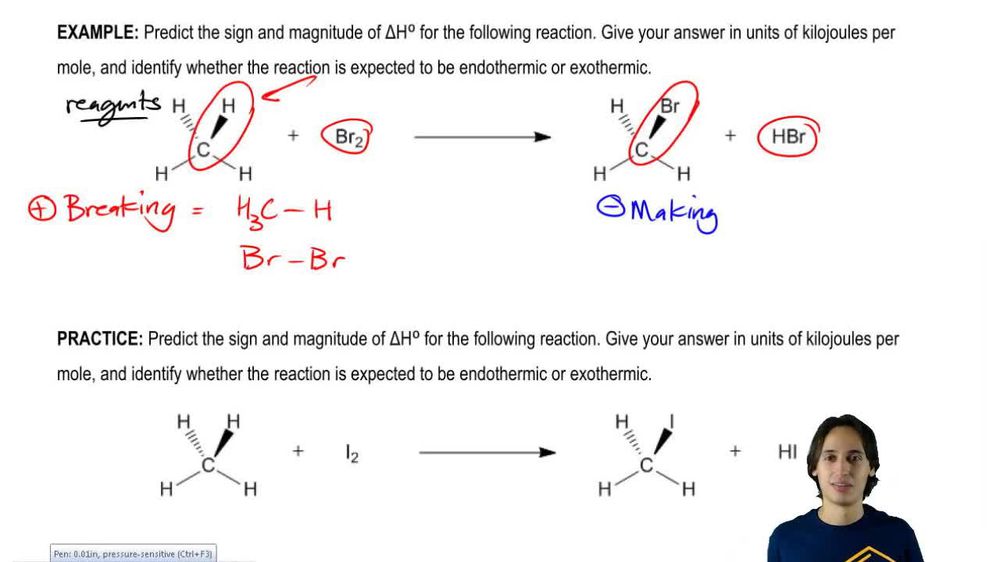
Identify the bonds broken and formed in the reaction. In this case, the bonds broken are the C-Cl bond in CH3CH2Cl and the H-I bond in HI. The bonds formed are the C-I bond in CH3CH2I and the H-Cl bond in HCl.
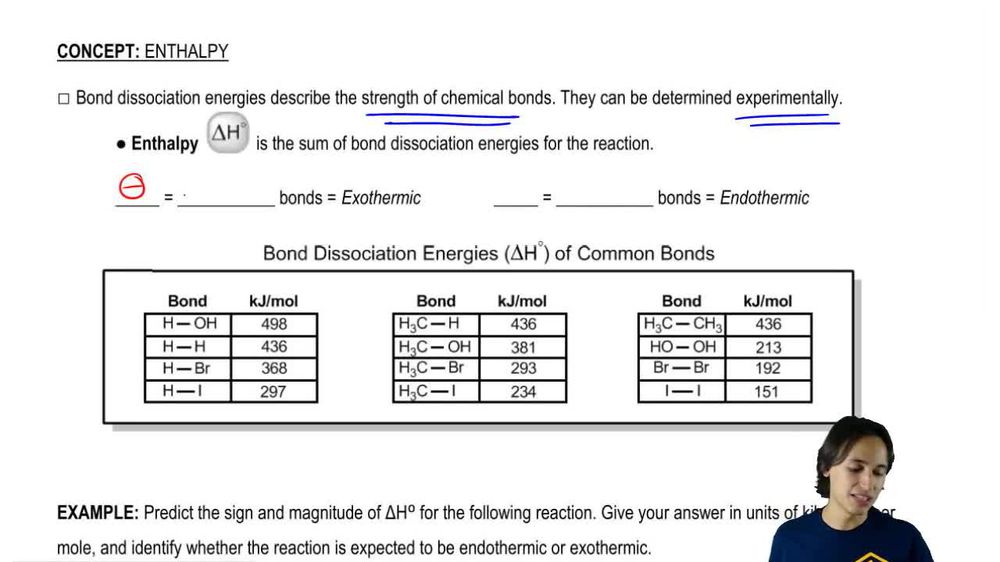
Look up the bond-dissociation enthalpies (BDEs) for each bond in the reaction. These values can be found in Table 4-2 on page 167. For example, the BDE for a C-Cl bond, H-I bond, C-I bond, and H-Cl bond should be noted.
Calculate the total energy required to break the bonds. This is the sum of the BDEs for the bonds broken: BDE(C-Cl) + BDE(H-I).
Calculate the total energy released when the new bonds are formed. This is the sum of the BDEs for the bonds formed: BDE(C-I) + BDE(H-Cl).
Determine the overall enthalpy change (ΔH°) for the reaction by subtracting the total energy released from the total energy required: ΔH° = [BDE(C-Cl) + BDE(H-I)] - [BDE(C-I) + BDE(H-Cl)].
Verified video answer for a similar problem:
This video solution was recommended by our tutors as helpful for the problem above
Video duration:
4m
Play a video:
0 Comments
Key Concepts
Here are the essential concepts you must grasp in order to answer the question correctly.
Bond-Dissociation Enthalpy
Bond-dissociation enthalpy (BDE) is the energy required to break a specific bond in a molecule, resulting in the formation of two radicals. It is a crucial concept in thermochemistry, as it helps predict the stability of molecules and the energy changes during chemical reactions. BDE values are typically provided in kilojoules per mole (kJ/mol) and vary depending on the type of bond and the molecular environment.
How to calculate enthalpy using bond dissociation energies.
Enthalpy Change (ΔH°)
Enthalpy change (ΔH°) refers to the heat content change of a system at constant pressure during a chemical reaction. It can be calculated using the bond-dissociation enthalpies of the reactants and products. The formula ΔH° = ΣBDE(reactants) - ΣBDE(products) allows chemists to determine whether a reaction is exothermic (releases heat) or endothermic (absorbs heat).
A reaction mechanism describes the step-by-step sequence of elementary reactions by which overall chemical change occurs. Understanding the mechanism helps in predicting the products and the energy changes involved. In the given reaction, the mechanism involves the breaking of C-Cl and H-I bonds and the formation of C-I and H-Cl bonds, which is essential for calculating the overall enthalpy change.