Calculate ∆G°, ∆H°, and ∆S° for the following acid–base reactions. Rationalize the value of ∆H° based on the structure of the conjugate bases. [Assume T = 298 K.] (b)
Verified step by step guidance
1
Step 1: Identify the acid and base in the reaction. The molecule on the left (with the -OH group) acts as the acid, donating a proton to form the conjugate base (on the right, with the -O⁻ group). The molecule on the right (with the -NH₃⁺ group) acts as the conjugate acid formed from the base.
Step 2: Write the expression for ∆G° using the equation ∆G° = ∆H° - T∆S°. Here, T is given as 298 K. To calculate ∆G°, you need the values of ∆H° and ∆S°, which can be determined experimentally or provided in the problem.
Step 3: Rationalize the value of ∆H° based on the structure of the conjugate bases. The conjugate base formed (with the -O⁻ group) is stabilized by resonance, as the negative charge can delocalize onto the carbonyl oxygen. This stabilization lowers the energy of the conjugate base, contributing to the enthalpy change (∆H°).
Step 4: Consider the entropy change (∆S°). The reaction involves the transfer of a proton, which may increase disorder in the system. Evaluate the molecular changes to determine whether ∆S° is positive or negative.
Step 5: Combine the calculated or provided values of ∆H° and ∆S° into the equation ∆G° = ∆H° - T∆S° to determine the Gibbs free energy change for the reaction. This will indicate whether the reaction is thermodynamically favorable under standard conditions.
Verified video answer for a similar problem:
This video solution was recommended by our tutors as helpful for the problem above
Play a video:
0 Comments
Key Concepts
Here are the essential concepts you must grasp in order to answer the question correctly.
Gibbs Free Energy (∆G°)
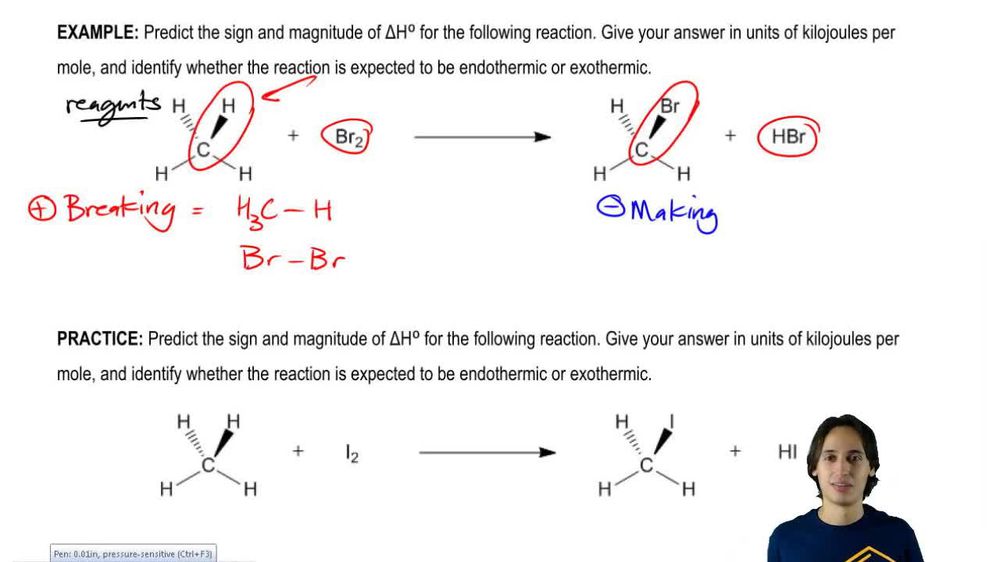
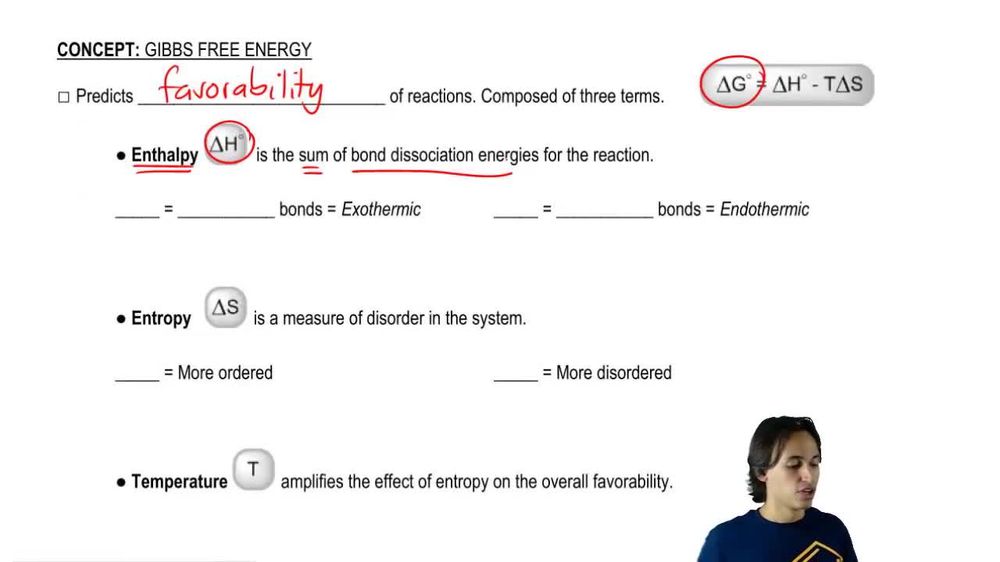
Gibbs Free Energy (∆G°) is a thermodynamic potential that measures the maximum reversible work obtainable from a thermodynamic system at constant temperature and pressure. It indicates the spontaneity of a reaction; a negative ∆G° suggests that the reaction can occur spontaneously, while a positive value indicates non-spontaneity. The relationship between ∆G°, enthalpy (∆H°), and entropy (∆S°) is given by the equation ∆G° = ∆H° - T∆S°, where T is the temperature in Kelvin.
Breaking down the different terms of the Gibbs Free Energy equation.
Enthalpy (∆H°)
Enthalpy (∆H°) is a measure of the total heat content of a system and reflects the energy changes during a chemical reaction. It can be either exothermic (releasing heat, ∆H° < 0) or endothermic (absorbing heat, ∆H° > 0). The value of ∆H° can be rationalized by examining the stability and structure of the reactants and products, particularly the strength of bonds formed and broken during the reaction, which influences the overall energy change.
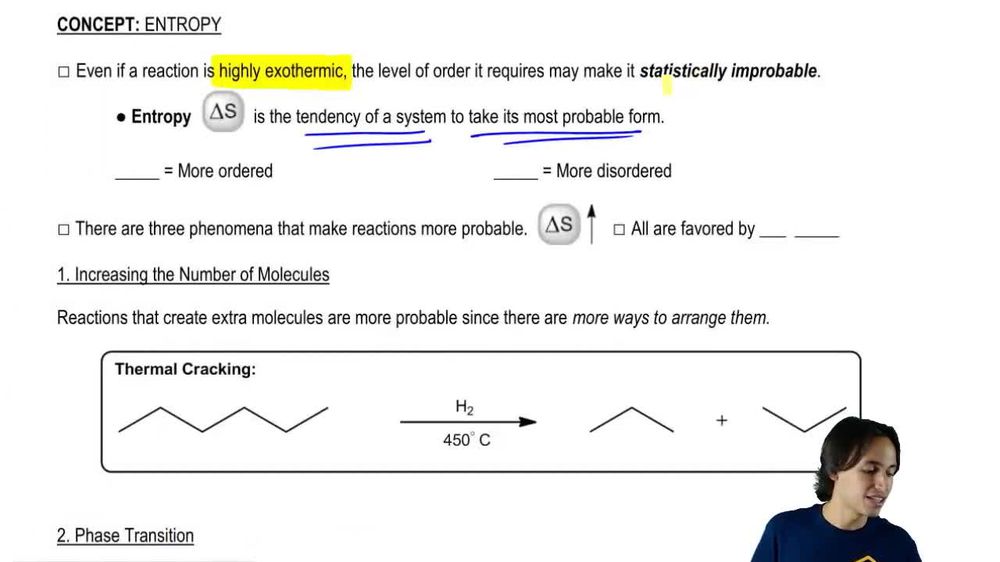
Entropy (∆S°) is a measure of the disorder or randomness in a system. In chemical reactions, an increase in entropy (∆S° > 0) typically corresponds to a greater number of microstates or configurations available to the system, often seen in reactions that produce gases from solids or liquids. Understanding the changes in entropy is crucial for predicting the spontaneity of reactions, as it directly influences the Gibbs Free Energy equation.