For each reaction, estimate whether ΔS° for the reaction is positive, negative, or impossible to predict. (a)
Verified step by step guidance
1
Step 1: Analyze the reaction. The reaction involves the catalytic cracking of n-decane (C₁₀H₂₂) into propene (C₃H₆) and heptane (C₇H₁₆). This process breaks a single large molecule into two smaller molecules.
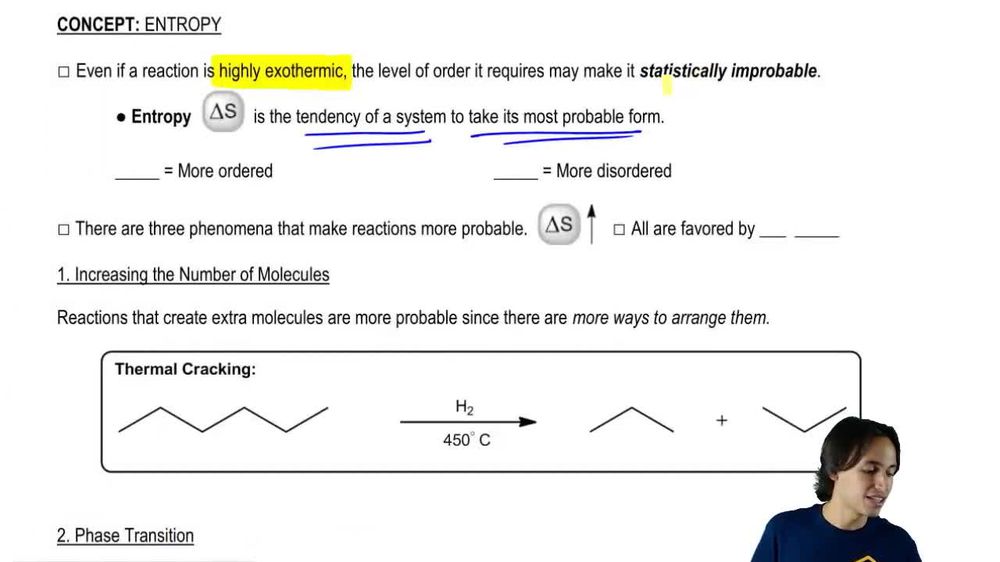
Step 2: Consider the change in the number of molecules. The reactant is one molecule of n-decane, while the products are two molecules (propene and heptane). An increase in the number of molecules generally leads to an increase in entropy (ΔS° > 0).
Step 3: Evaluate the physical states of the reactants and products. n-Decane is a liquid at standard conditions, while propene is a gas and heptane is a liquid. The formation of a gaseous product (propene) from a liquid reactant contributes to an increase in entropy.
Step 4: Consider molecular complexity. Breaking a larger molecule into smaller fragments typically increases the disorder of the system, further supporting a positive ΔS°.
Step 5: Conclude the estimation. Based on the increase in the number of molecules, the formation of a gaseous product, and the increase in disorder, ΔS° for this reaction is likely positive.
Verified video answer for a similar problem:
This video solution was recommended by our tutors as helpful for the problem above
Video duration:
2m
Play a video:
0 Comments
Key Concepts
Here are the essential concepts you must grasp in order to answer the question correctly.
Entropy (ΔS°)
Entropy, represented as ΔS°, is a measure of the disorder or randomness in a system. In chemical reactions, an increase in the number of gas molecules or a transition from a more ordered to a less ordered state typically results in a positive ΔS°, indicating greater disorder. Conversely, a decrease in the number of gas molecules or a transition to a more ordered state results in a negative ΔS°.
Catalytic cracking is a process used in the petroleum industry to break down large hydrocarbon molecules into smaller, more valuable products like gasoline and olefins. This reaction typically involves the use of heat and a catalyst, which facilitates the breaking of carbon-carbon bonds, leading to the formation of smaller alkanes and alkenes, such as propene and heptane in the given reaction.
The products of a reaction can significantly influence the entropy change (ΔS°). In the provided reaction, n-decane (C10H22) is converted into propene (C3H6) and heptane (C7H16). Since the reaction produces a gaseous product (propene) alongside a liquid product (heptane), the overall disorder of the system increases, suggesting a positive ΔS° due to the generation of more gaseous molecules.