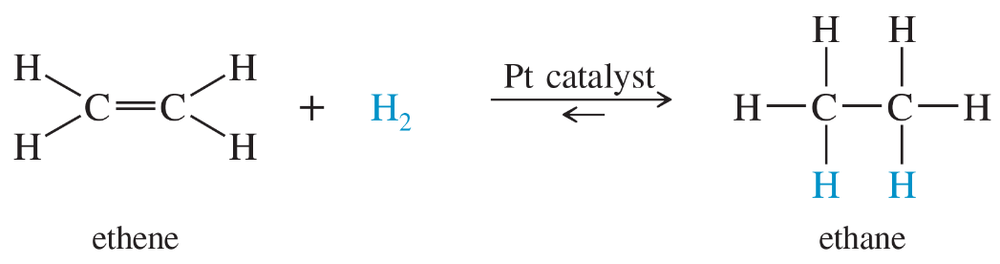
When ethene is mixed with hydrogen in the presence of a platinum catalyst, hydrogen adds across the double bond to form ethane. At room temperature, the reaction goes to completion. Predict the signs of ΔH° and ΔS° for this reaction. Explain these signs in terms of bonding and freedom of motion.
Verified step by step guidance
1
Step 1: Analyze the reaction. The reaction involves the addition of hydrogen (H₂) to ethene (C₂H₄) in the presence of a platinum catalyst, resulting in the formation of ethane (C₂H₆). This is a hydrogenation reaction where the double bond in ethene is converted into a single bond in ethane.
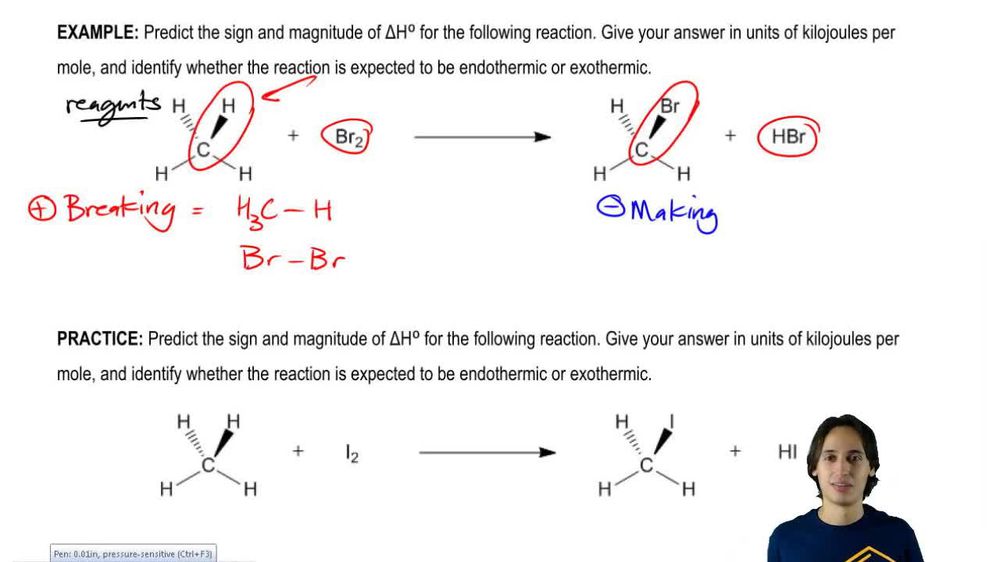
Step 2: Predict the sign of ΔH°. The reaction involves breaking the π bond in the double bond of ethene and forming two new C-H σ bonds in ethane. Since σ bonds are stronger and more stable than π bonds, the reaction releases energy. Therefore, ΔH° (enthalpy change) is negative, indicating an exothermic reaction.
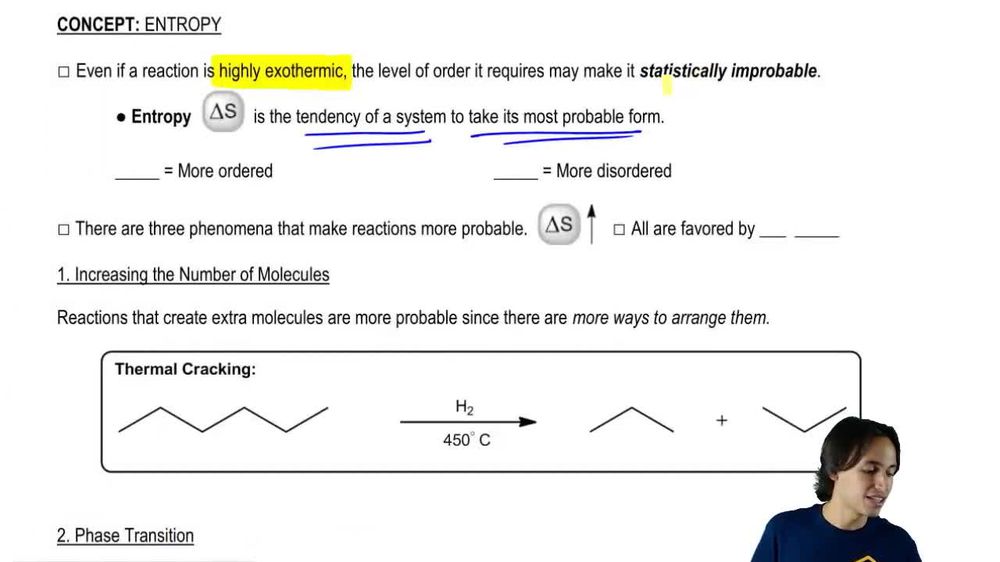
Step 3: Predict the sign of ΔS°. The reaction starts with two reactant molecules (ethene and H₂) and produces one product molecule (ethane). This reduction in the number of molecules leads to a decrease in the system's randomness or disorder. Therefore, ΔS° (entropy change) is negative.
Step 4: Explain ΔH° in terms of bonding. The breaking of the weaker π bond in ethene and the formation of stronger C-H σ bonds in ethane result in a net release of energy, making the reaction exothermic (negative ΔH°).
Step 5: Explain ΔS° in terms of freedom of motion. The reactants (ethene and H₂) have more freedom of motion as separate molecules compared to the single product (ethane). This reduction in molecular freedom leads to a decrease in entropy (negative ΔS°).
Verified video answer for a similar problem:
This video solution was recommended by our tutors as helpful for the problem above
Video duration:
6m
Play a video:
0 Comments
Key Concepts
Here are the essential concepts you must grasp in order to answer the question correctly.
Enthalpy Change (ΔH°)
The enthalpy change (ΔH°) of a reaction indicates whether the reaction is exothermic or endothermic. In the case of the hydrogenation of ethene to form ethane, the reaction releases energy as new C-H bonds are formed, resulting in a negative ΔH°. This signifies that the products are more stable than the reactants due to the formation of stronger bonds.
Entropy change (ΔS°) measures the disorder or randomness in a system. In the hydrogenation reaction, two gaseous reactants (ethene and hydrogen) combine to form one gaseous product (ethane), leading to a decrease in the number of gas molecules. This results in a negative ΔS°, indicating a reduction in the system's disorder as the reaction proceeds.
Catalysis involves the use of a catalyst to increase the rate of a chemical reaction without being consumed in the process. In this reaction, platinum acts as a catalyst, facilitating the addition of hydrogen across the double bond of ethene. The presence of the catalyst lowers the activation energy required for the reaction, allowing it to proceed more efficiently at room temperature.