Predict the product(s) of the reactions shown. (j)
Verified step by step guidance
1
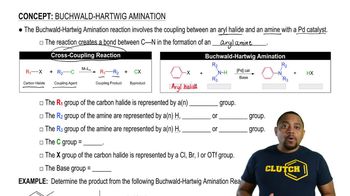
Identify the type of reaction: The presence of Pd(PPh3)4 and NaOt-Bu suggests a Buchwald-Hartwig amination reaction, which is used to form C-N bonds by coupling aryl halides with amines.
Examine the reactants: The aryl halide is a bromobenzene derivative with methoxy (OMe) and trifluoromethyl (CF3) substituents. The amine is a cyclic secondary amine, pyrrolidine.
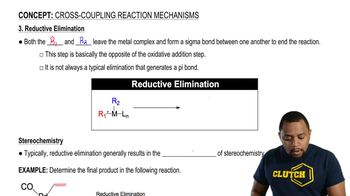
Consider the mechanism: The palladium catalyst facilitates the oxidative addition of the aryl bromide, forming a palladium-aryl complex. The amine then coordinates to the palladium, followed by reductive elimination to form the C-N bond.
Predict the product: The reaction will replace the bromine atom on the benzene ring with the pyrrolidine group, resulting in the formation of an aryl amine.
Evaluate the regioselectivity: The methoxy and trifluoromethyl groups are ortho and para directing, but since the bromine is already positioned, the reaction will proceed at the bromine site without affecting the substituents.
Verified video answer for a similar problem:
This video solution was recommended by our tutors as helpful for the problem above
Video duration:
3m
Play a video:
0 Comments
Key Concepts
Here are the essential concepts you must grasp in order to answer the question correctly.
Buchwald-Hartwig Amination
The Buchwald-Hartwig amination is a palladium-catalyzed coupling reaction that forms carbon-nitrogen bonds between aryl halides and amines. In this reaction, the palladium catalyst facilitates the replacement of the halide (Br) on the aromatic ring with an amine group, resulting in the formation of an aryl amine. This reaction is widely used in the synthesis of pharmaceuticals and organic materials.
Palladium catalysts, such as Pd(PPh3)4, are crucial in facilitating cross-coupling reactions like the Buchwald-Hartwig amination. The palladium catalyst undergoes oxidative addition with the aryl halide, forming a palladium complex that can then react with the amine. This process allows for the formation of a new C-N bond, and the catalyst is regenerated at the end of the reaction cycle.
In cross-coupling reactions, a base like NaOt-Bu is often used to deprotonate the amine, increasing its nucleophilicity and facilitating its reaction with the palladium complex. The base also helps in the regeneration of the active palladium catalyst by removing the halide ion. This step is essential for the completion of the catalytic cycle and the successful formation of the desired product.