Predict the major products of the following reactions, including stereochemistry where appropriate. (h) cyclooctylmethanol + CH3CH2MgBr (i) potassium tert-butoxide + methyl iodide (j) sodium methoxide + tert-butyl iodide
Verified step by step guidance
1
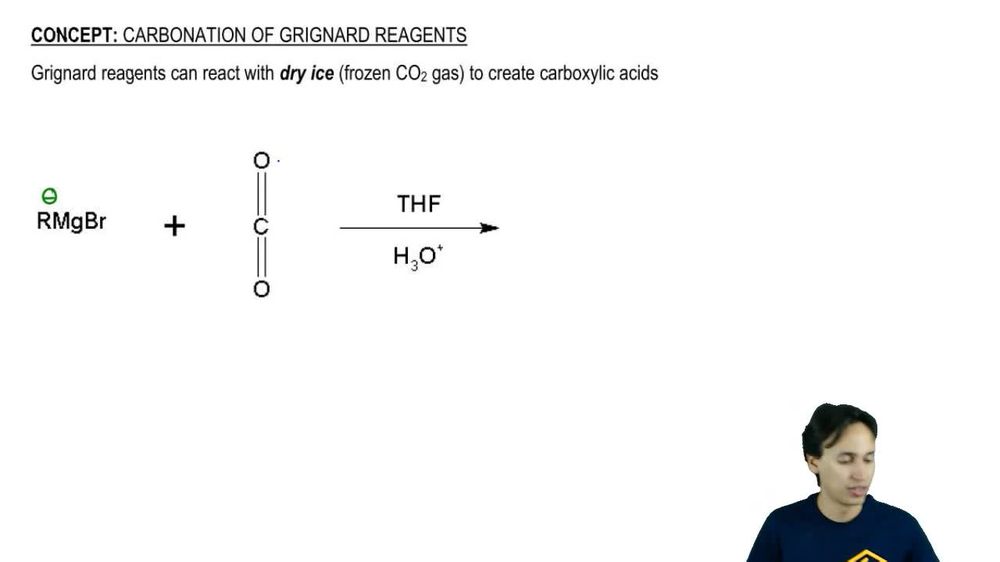
Step 1: For reaction (h), cyclooctylmethanol reacts with CH3CH2MgBr, a Grignard reagent. Grignard reagents are strong nucleophiles and bases. The hydroxyl group (-OH) in cyclooctylmethanol will react with the Grignard reagent, leading to the formation of a cyclooctylmethoxide intermediate and ethane gas (CH3CH3). This reaction does not proceed further to form a carbon-carbon bond because the alcohol group is acidic and reacts with the Grignard reagent.
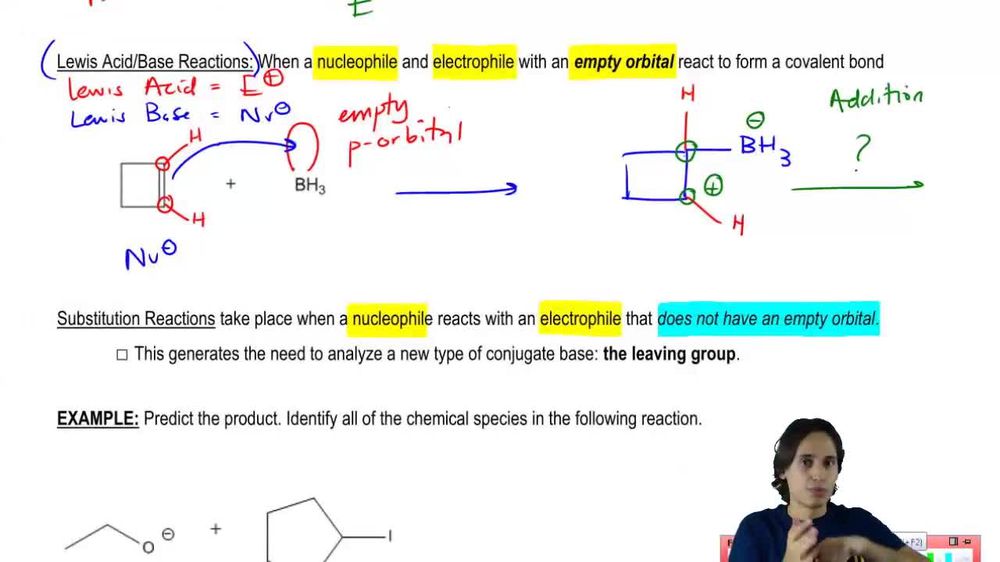
Step 2: For reaction (i), potassium tert-butoxide (KOtBu) reacts with methyl iodide (CH3I). This is an example of an SN2 reaction, where the nucleophile (tert-butoxide ion) attacks the electrophilic carbon in methyl iodide, displacing the iodide ion. The product formed is tert-butyl methyl ether (CH3-O-C(CH3)3). The reaction proceeds with inversion of configuration at the electrophilic carbon, but since methyl iodide is achiral, stereochemistry is not relevant here.
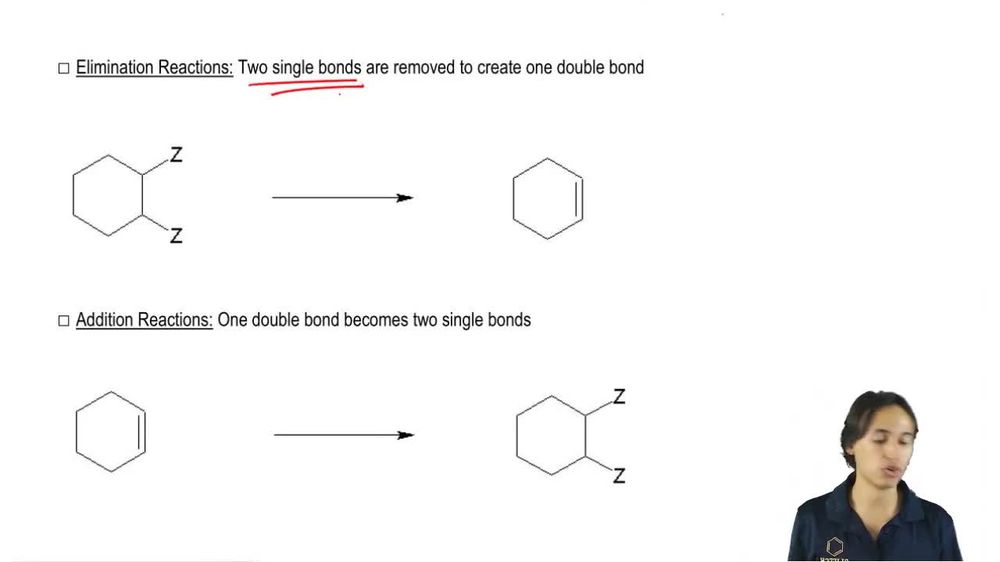
Step 3: For reaction (j), sodium methoxide (CH3ONa) reacts with tert-butyl iodide (C(CH3)3I). Due to the steric hindrance around the tert-butyl group, an SN2 reaction is unlikely. Instead, this reaction proceeds via an E2 elimination mechanism. Sodium methoxide acts as a strong base, abstracting a proton from one of the methyl groups adjacent to the carbon bonded to iodine. This leads to the formation of isobutene (CH2=C(CH3)2) and sodium iodide (NaI).
Step 4: In reaction (h), the Grignard reagent acts as a base rather than a nucleophile due to the presence of the hydroxyl group. This is a key concept to understand when predicting the outcome of reactions involving alcohols and Grignard reagents.
Step 5: In reactions (i) and (j), the steric hindrance and the nature of the nucleophile/base determine whether the reaction proceeds via SN2 or E2 mechanisms. Understanding these factors is crucial for predicting the major product and stereochemistry of such reactions.
Verified video answer for a similar problem:
This video solution was recommended by our tutors as helpful for the problem above
Video duration:
7m
Play a video:
0 Comments
Key Concepts
Here are the essential concepts you must grasp in order to answer the question correctly.
Grignard Reagents
Grignard reagents, such as CH3CH2MgBr, are organomagnesium compounds that act as nucleophiles in organic reactions. They can react with electrophiles, including carbonyl compounds, to form alcohols. In the context of the first reaction, cyclooctylmethanol will react with the Grignard reagent to form a new carbon-carbon bond, leading to the formation of a more complex alcohol.
Elimination reactions involve the removal of a small molecule from a larger one, often resulting in the formation of a double bond. In the second reaction, potassium tert-butoxide acts as a strong base, promoting the elimination of iodide from methyl iodide to form an alkene. Understanding the mechanism of elimination is crucial for predicting the products and their stereochemistry.
Nucleophilic substitution is a fundamental reaction in organic chemistry where a nucleophile replaces a leaving group in a molecule. In the third reaction, sodium methoxide acts as a nucleophile, attacking the tert-butyl iodide to displace the iodide ion. The mechanism (either SN1 or SN2) will influence the stereochemistry of the product, making it essential to consider when predicting the outcome.