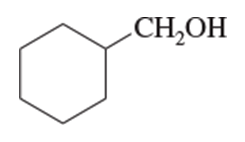
Show how you would synthesize the following primary alcohol by adding an appropriate Grignard reagent to formaldehyde. (a)
Verified step by step guidance
1
Step 1: Identify the target molecule. The primary alcohol shown in the first image is benzyl alcohol (C6H5CH2OH), and the second image shows cyclohexylmethanol (C6H11CH2OH). Both are primary alcohols that can be synthesized using a Grignard reagent and formaldehyde.
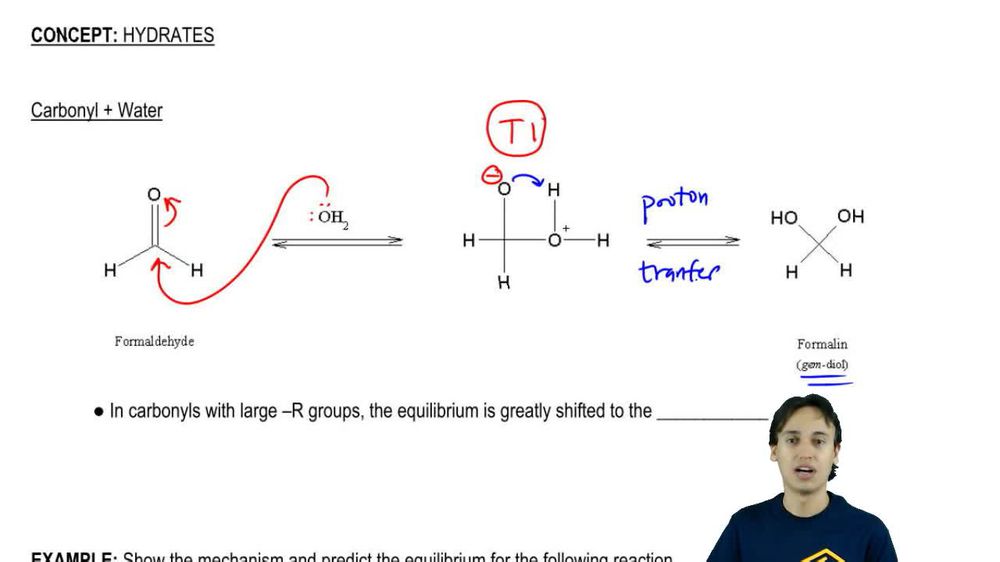
Step 2: Recall the general reaction mechanism for Grignard reagents with formaldehyde. A Grignard reagent (R-MgX) reacts with formaldehyde (HCHO) to form a primary alcohol after hydrolysis. The R group from the Grignard reagent becomes the alkyl group attached to the hydroxyl group in the alcohol.
Step 3: For benzyl alcohol synthesis, choose the appropriate Grignard reagent. The Grignard reagent should be phenylmagnesium bromide (C6H5MgBr), as the phenyl group (C6H5-) will attach to the formaldehyde carbon during the reaction.
Step 4: For cyclohexylmethanol synthesis, choose the appropriate Grignard reagent. The Grignard reagent should be cyclohexylmagnesium bromide (C6H11MgBr), as the cyclohexyl group (C6H11-) will attach to the formaldehyde carbon during the reaction.
Step 5: Perform the reaction. Add the chosen Grignard reagent to formaldehyde in an ether solvent to form the intermediate alkoxide. Then, hydrolyze the intermediate with water or dilute acid to yield the desired primary alcohol.
Verified video answer for a similar problem:
This video solution was recommended by our tutors as helpful for the problem above
Video duration:
3m
Play a video:
0 Comments
Key Concepts
Here are the essential concepts you must grasp in order to answer the question correctly.
Grignard Reagents
Grignard reagents are organomagnesium compounds that are highly reactive and used in organic synthesis to form carbon-carbon bonds. They are created by reacting an alkyl or aryl halide with magnesium metal in an anhydrous ether solvent. When Grignard reagents react with carbonyl compounds, such as formaldehyde, they add to the carbonyl carbon, leading to the formation of alcohols after subsequent hydrolysis.
Formaldehyde is the simplest aldehyde, with the chemical formula CH2O. It is a reactive carbonyl compound that can undergo nucleophilic addition reactions. When a Grignard reagent reacts with formaldehyde, it forms a primary alcohol after hydrolysis, as the Grignard reagent adds to the carbonyl carbon, resulting in a new carbon-carbon bond and a hydroxyl group.
The synthesis of alcohols from carbonyl compounds is a fundamental reaction in organic chemistry. This process typically involves nucleophilic addition, where a nucleophile (like a Grignard reagent) attacks the electrophilic carbon of the carbonyl group. The resulting alkoxide intermediate can be protonated to yield the corresponding alcohol, which is crucial for building complex organic molecules.