The mass spectrum for a compound with molecular weight of 102 is shown below. Its IR spectrum has a broad, strong absorption at 3600 cm–1 and a medium absorption at 1360 cm–1. a. Identify the compound. <IMAGE>
Verified step by step guidance
1
Step 1: Analyze the molecular weight of the compound, which is given as 102. This indicates the molecular ion peak (M+) in the mass spectrum should be at m/z = 102.
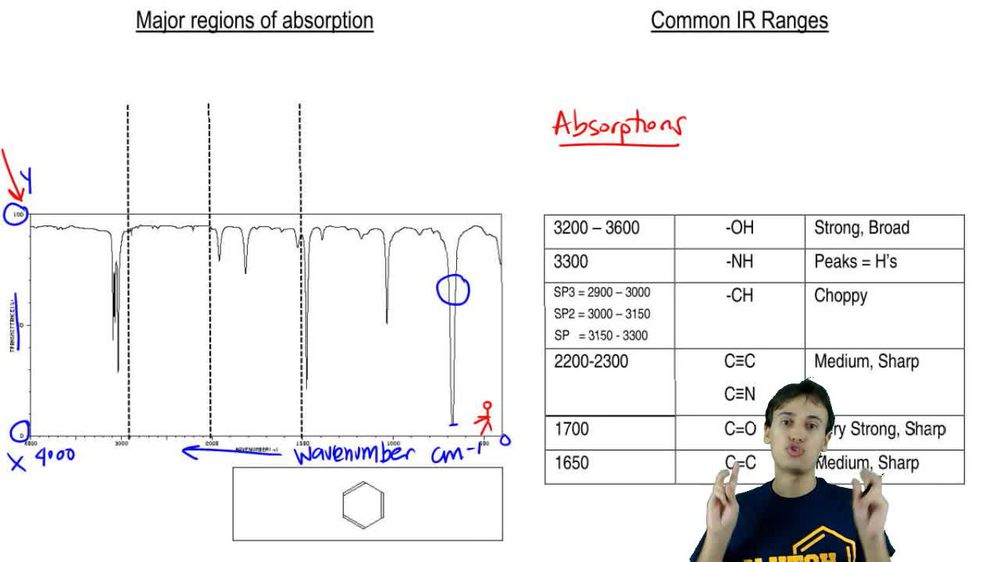
Step 2: Examine the IR spectrum data. The broad, strong absorption at 3600 cm⁻¹ suggests the presence of an -OH group, characteristic of alcohols. The medium absorption at 1360 cm⁻¹ indicates possible C-H bending vibrations, often associated with methyl groups.
Step 3: Look at the mass spectrum provided. The molecular ion peak (M+) at m/z = 102 confirms the molecular weight. Fragmentation patterns, such as peaks at m/z = 45 and m/z = 70, suggest possible loss of functional groups or fragments like CH3 or CH2OH.
Step 4: Combine the IR and mass spectrum data. The presence of an -OH group (from IR) and fragmentation patterns (from mass spectrum) suggest the compound is likely an alcohol. The molecular formula could be C4H10O, which matches the molecular weight of 102.
Step 5: Based on the data, the compound is likely butanol (C4H10O), as it fits the molecular weight, IR absorption characteristics, and fragmentation patterns observed in the mass spectrum.
Verified video answer for a similar problem:
This video solution was recommended by our tutors as helpful for the problem above
Video duration:
5m
Play a video:
0 Comments
Key Concepts
Here are the essential concepts you must grasp in order to answer the question correctly.
Mass Spectrometry
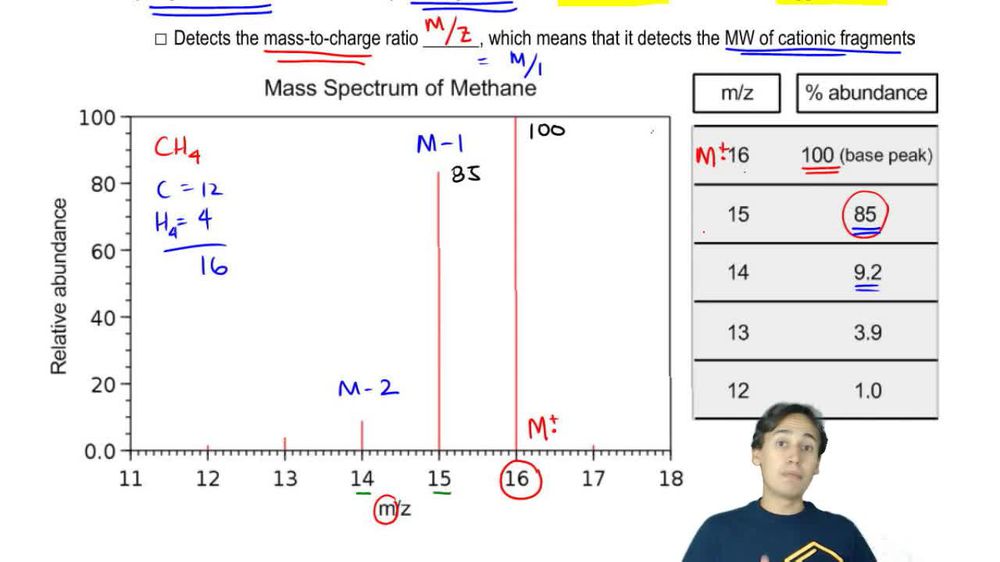
Mass spectrometry is an analytical technique used to measure the mass-to-charge ratio of ions. It provides information about the molecular weight of a compound and its structural features. In the context of the question, the mass spectrum indicates a molecular ion peak corresponding to the molecular weight of 102, which helps in identifying the compound.
Infrared spectroscopy is a technique that measures the absorption of infrared light by a compound, providing information about its functional groups. The broad absorption at 3600 cm–1 suggests the presence of an -OH group, while the medium absorption at 1360 cm–1 may indicate a C-H bending vibration, which is common in alkanes or aromatic compounds.
Identifying functional groups is crucial in organic chemistry as they determine the chemical reactivity and properties of compounds. The combination of mass spectrometry and IR spectroscopy data allows for the deduction of possible structures for the compound with a molecular weight of 102, guiding the identification process.

 5:18 minutes
 Verified step by step guidance
 01:25
01:25