The mass spectrum of tert-butylamine follows shows an intense base peak at m/z 58, and very little else. Use a diagram to show the cleavage that accounts for the base peak. Suggest why no molecular ion is visible in this spectrum.
Verified step by step guidance
1
Analyze the mass spectrum provided. The base peak at m/z 58 indicates the most stable and abundant fragment ion formed during the fragmentation of tert-butylamine.
Understand the structure of tert-butylamine: (CH3)3CNH2. The molecule consists of a tert-butyl group ((CH3)3C-) attached to an amine (-NH2). Fragmentation typically occurs at the weakest bond or the most favorable cleavage site.
Propose the cleavage mechanism: The bond between the tert-butyl group and the amine group is likely to break, forming a stable carbocation (C4H10+, m/z 58). This carbocation is stabilized by hyperconjugation and inductive effects from the three methyl groups.
Explain the absence of a molecular ion peak: The molecular ion (m/z 73 for tert-butylamine) is likely absent due to its instability. Tert-butylamine undergoes rapid fragmentation upon ionization, favoring the formation of the stable m/z 58 fragment instead of retaining the molecular ion.
Draw a diagram to illustrate the cleavage: Show the tert-butylamine structure, the bond cleavage between the tert-butyl group and the amine group, and the formation of the stable carbocation (C4H10+, m/z 58). This visual representation helps clarify the fragmentation process.
Verified video answer for a similar problem:
This video solution was recommended by our tutors as helpful for the problem above
Video duration:
6m
Play a video:
0 Comments
Key Concepts
Here are the essential concepts you must grasp in order to answer the question correctly.
Mass Spectrometry
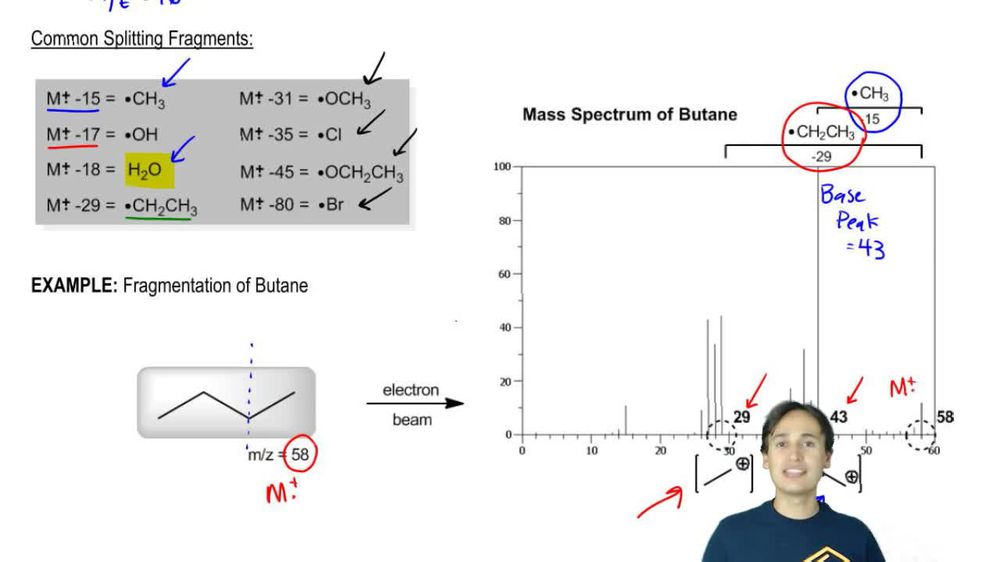
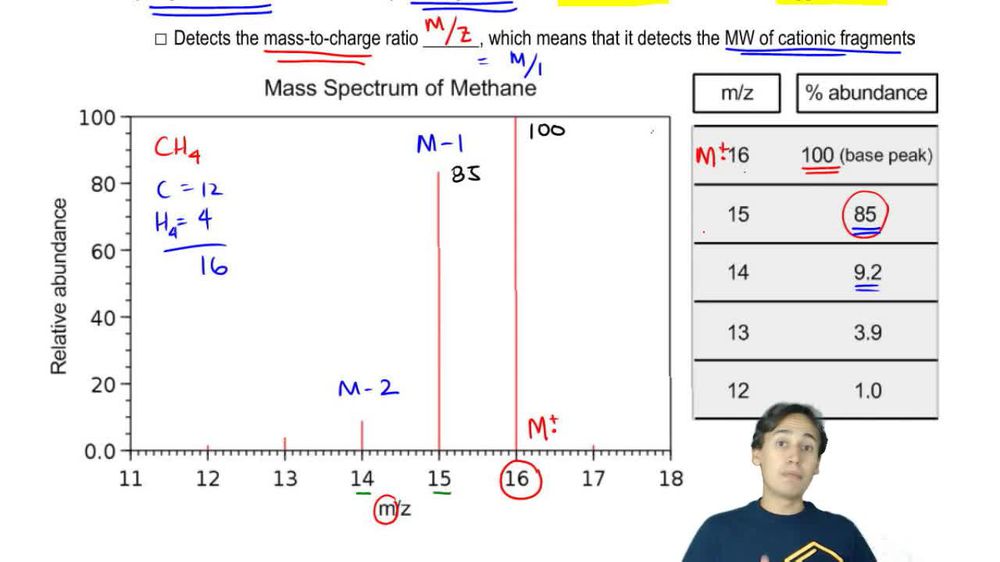
Mass spectrometry is an analytical technique used to measure the mass-to-charge ratio of ions. It involves ionizing chemical species and sorting the resulting ions based on their mass. The output is a mass spectrum, which displays the relative abundance of detected ions at various mass-to-charge (m/z) ratios, providing insights into the molecular structure and composition of the sample.
The base peak in a mass spectrum is the peak with the highest intensity, representing the most abundant ion detected. In the case of tert-butylamine, the base peak at m/z 58 indicates a stable fragment ion resulting from the cleavage of the molecule. Understanding the base peak helps in identifying the most significant fragmentation pathways and the structure of the compound.
The molecular ion is the ion that corresponds to the intact molecule of the analyte, typically represented as M+. Its absence in a mass spectrum can indicate that the molecule has fragmented before detection, often due to instability or the presence of weak bonds. In tert-butylamine's spectrum, the lack of a molecular ion suggests that fragmentation occurs readily, leading to the formation of smaller, more stable ions.

 6:23 minutes
 Verified step by step guidance
 01:25
01:25