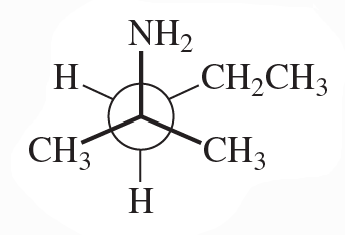
Convert the following Newman projections to skeletal structures and name them. a. b.
Verified step by step guidance
1
Examine the Newman projection carefully. Identify the front carbon (the circle) and the back carbon (the dot behind the circle). Note the substituents attached to each carbon and their relative positions (e.g., staggered or eclipsed).
Determine the connectivity of the substituents to the front and back carbons. Translate this information into a 2D skeletal structure by arranging the substituents around the carbons in the correct spatial orientation.
Draw the skeletal structure by representing the carbon chain as a zigzag line, with substituents branching off at the appropriate positions. Use wedges and dashes to indicate substituents that are coming out of or going into the plane of the paper, if necessary.
Verify the structure by ensuring that the connectivity and spatial arrangement of substituents in the skeletal structure match the Newman projection. Double-check for any stereochemical details, such as chirality centers, if present.
Name the compound according to IUPAC nomenclature rules. Identify the parent chain, number the carbons to give substituents the lowest possible numbers, and list substituents alphabetically in the name.
Verified video answer for a similar problem:
This video solution was recommended by our tutors as helpful for the problem above
Video duration:
3m
Play a video:
0 Comments
Key Concepts
Here are the essential concepts you must grasp in order to answer the question correctly.
Newman Projections
Newman projections are a way to visualize the conformation of a molecule by looking straight down the bond connecting two carbon atoms. This representation helps in understanding the spatial arrangement of substituents around the bond, which is crucial for analyzing steric interactions and torsional strain in organic compounds.
Skeletal structures, or line-angle formulas, are simplified representations of organic molecules where carbon atoms are represented by vertices and hydrogen atoms are often omitted for clarity. This format allows chemists to easily visualize the connectivity and functional groups within a molecule, making it essential for naming and understanding organic compounds.
The nomenclature of organic compounds follows specific rules set by the International Union of Pure and Applied Chemistry (IUPAC). This system provides a standardized way to name compounds based on their structure, including the longest carbon chain, functional groups, and substituents, which is vital for clear communication in chemistry.

 3:47 minutes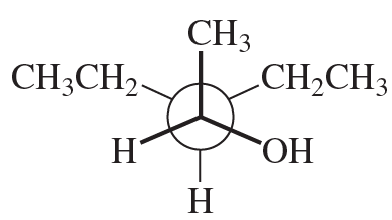
 Verified step by step guidance

 00:34
00:34