Draw a Newman projection, similar to Figure 3-25 down the C1—C6 bond in the equatorial conformation of methylcyclohexane. Show that the equatorial methyl group is also anti to C5. (Using your models will help.) <IMAGE>
Verified step by step guidance
1
Step 1: Understand the problem. You are tasked with drawing a Newman projection down the C1-C6 bond in the equatorial conformation of methylcyclohexane. The goal is to show that the equatorial methyl group is anti to C5.
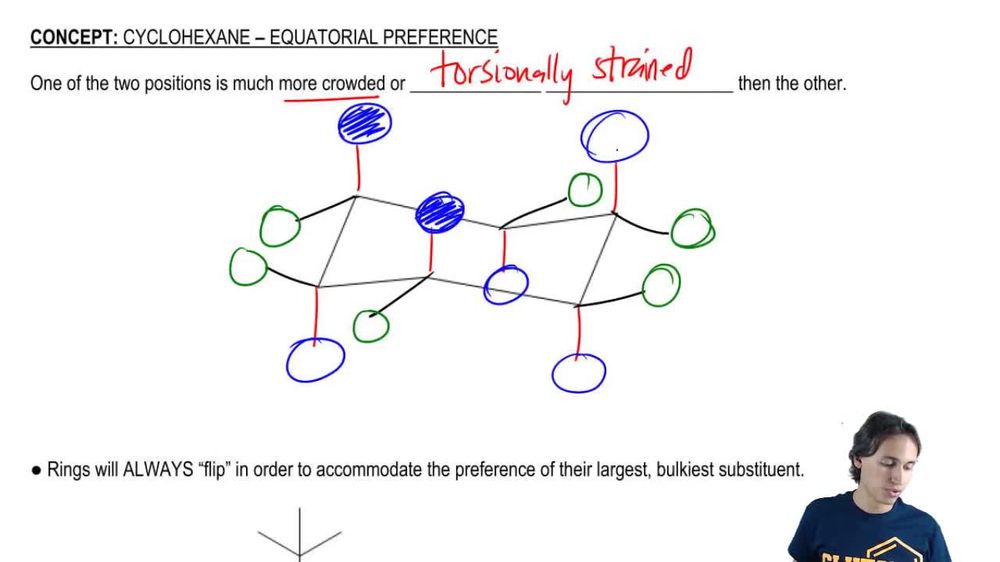
Step 2: Recall the chair conformation of cyclohexane. In the equatorial conformation, substituents are positioned outward from the ring, parallel to the plane of the ring. The axial positions alternate up and down, while the equatorial positions alternate slightly outward.
Step 3: Visualize the C1-C6 bond. In the chair conformation, C1 is at the front and C6 is at the back. To draw the Newman projection, imagine looking directly down the C1-C6 bond axis.
Step 4: Place the substituents in the Newman projection. At C1 (front carbon), the equatorial methyl group (CH3) will be positioned anti to the hydrogen on C5. At C6 (back carbon), the substituents will include hydrogens and the rest of the cyclohexane ring.
Step 5: Confirm the anti relationship. In the Newman projection, the equatorial methyl group at C1 will be directly opposite (anti) to the hydrogen on C5, as shown in the diagram. This anti relationship is due to the spatial arrangement in the chair conformation.
Verified video answer for a similar problem:
This video solution was recommended by our tutors as helpful for the problem above
Video duration:
7m
Play a video:
0 Comments
Key Concepts
Here are the essential concepts you must grasp in order to answer the question correctly.
Newman Projections
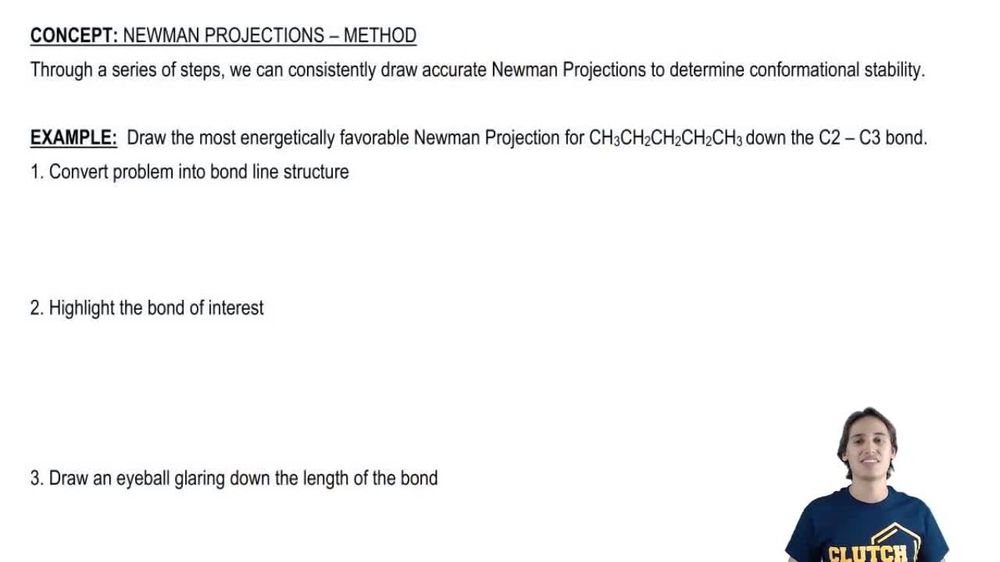
Newman projections are a way to visualize the conformation of a molecule by looking straight down a bond connecting two carbon atoms. This representation helps in understanding steric interactions and torsional strain between substituents attached to the carbons. In the case of methylcyclohexane, drawing the Newman projection along the C1—C6 bond allows for a clear view of the spatial arrangement of the methyl group and other substituents.
In cyclohexane derivatives, substituents can occupy either equatorial or axial positions. The equatorial position is generally more stable as it minimizes steric hindrance with other axial substituents. In methylcyclohexane, the equatorial conformation allows the methyl group to be positioned away from the ring, reducing steric strain and making it easier to analyze its interactions with other groups, such as the C5 carbon.
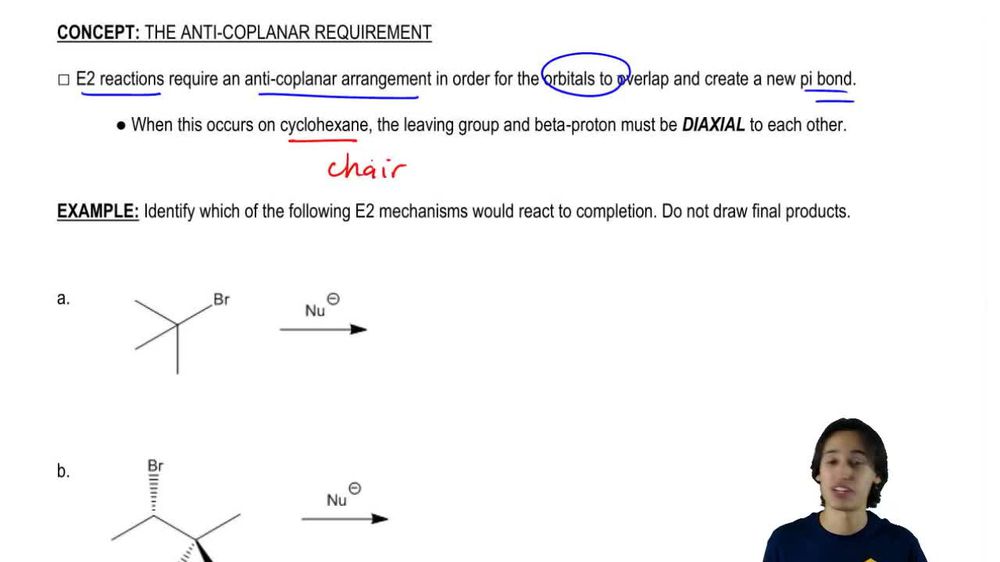
The term 'anti' refers to a specific spatial arrangement where two substituents are positioned 180 degrees apart in a Newman projection. In the context of methylcyclohexane, showing that the equatorial methyl group is anti to the C5 carbon means that these two groups are aligned in such a way that they are directly opposite each other, which is a favorable arrangement that minimizes steric interactions.