Draw Newman projections of the following molecules viewed from the direction of the blue arrows. (a)
Verified step by step guidance
1
Identify the carbon-carbon bond that the blue arrow is pointing towards. This will be the axis of rotation for your Newman projection.
Determine the groups attached to the front carbon (the carbon closest to the viewer) and the back carbon (the carbon furthest from the viewer).
Draw a circle to represent the back carbon. The front carbon is represented by a dot in the center of the circle.
Arrange the substituents around the front carbon as three lines radiating from the center dot. These lines should be spaced 120 degrees apart.
Arrange the substituents around the back carbon as three lines radiating from the circle. These lines should also be spaced 120 degrees apart, but staggered relative to the front carbon's substituents.
Verified video answer for a similar problem:
This video solution was recommended by our tutors as helpful for the problem above
Video duration:
3m
Play a video:
0 Comments
Key Concepts
Here are the essential concepts you must grasp in order to answer the question correctly.
Newman Projection
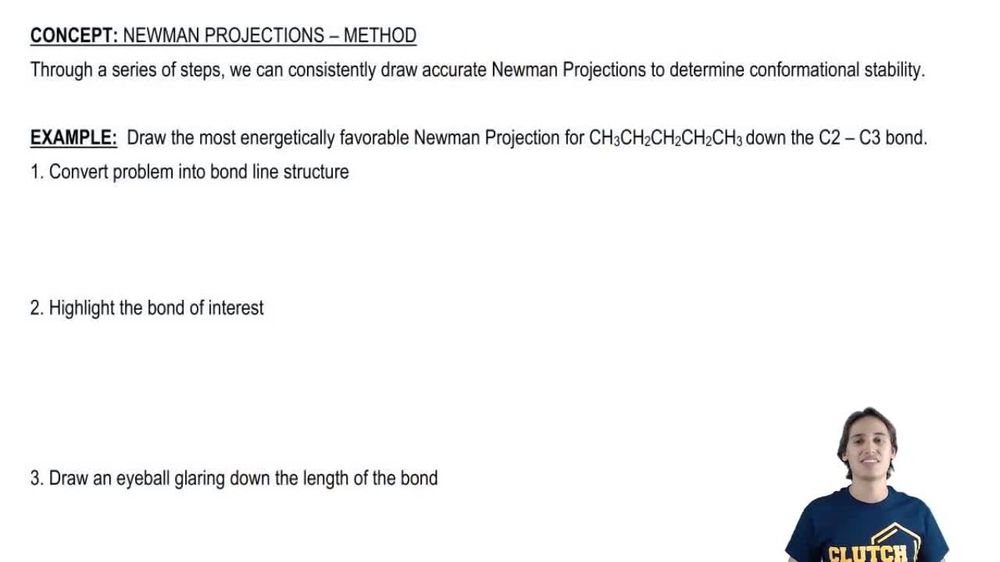
A Newman projection is a way of drawing a molecule to show the conformation of a carbon-carbon bond. It is viewed along the axis of the bond, with the front carbon represented by a dot and the back carbon by a circle. This projection helps visualize the spatial arrangement of substituents around the bond, which is crucial for understanding steric interactions and conformational isomerism.
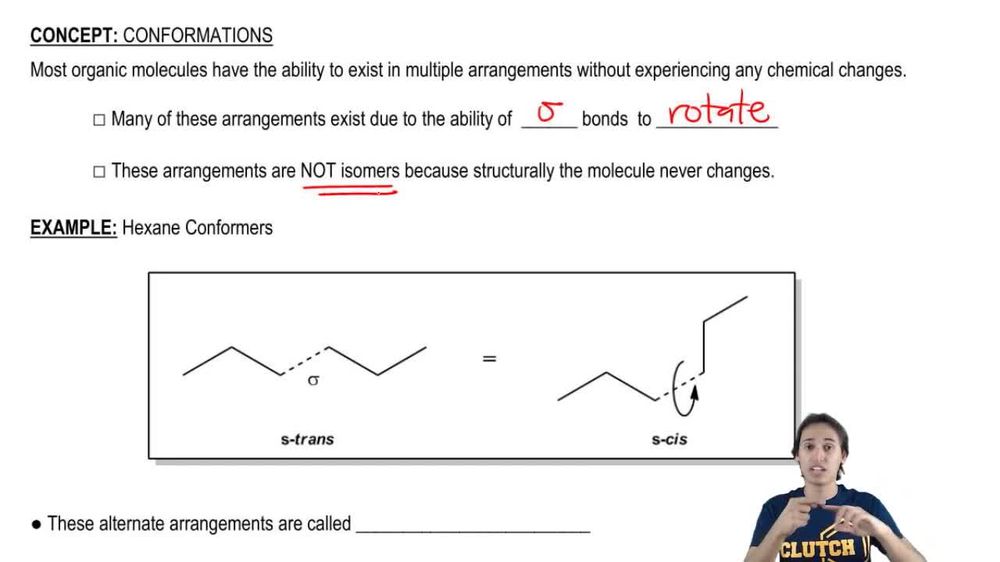
Conformational isomerism refers to the different spatial arrangements of atoms that result from rotation around a single bond. These isomers, also known as conformers, can interconvert through simple rotations. Understanding conformational isomerism is essential for analyzing the stability and reactivity of molecules, as different conformations can have significantly different energies and properties.
Steric hindrance occurs when atoms or groups within a molecule are positioned such that they physically impede each other's space, leading to increased energy and decreased stability. In Newman projections, steric hindrance is often visualized by the proximity of substituents on adjacent carbons. Recognizing steric hindrance is important for predicting the most stable conformations and understanding reaction mechanisms.

 3:04 minutes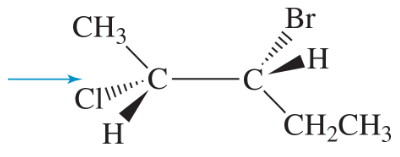
 Verified step by step guidance
 00:34
00:34