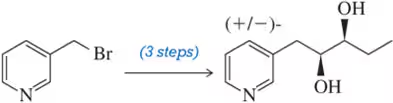
Beginning with the molecules on the left, provide a synthesis of the molecule on the right. The ideal number of steps is indicated over the reaction arrow, although there may be alternate routes worth considering. (b)
Verified step by step guidance
1
Analyze the target molecule and the starting material to identify the functional groups present and the changes required to convert the starting material into the target molecule. Look for key transformations such as addition, elimination, substitution, or rearrangement reactions.
Determine the carbon skeleton of the target molecule and compare it to the starting material. If the carbon skeleton differs, consider carbon-carbon bond-forming reactions such as aldol condensation, Grignard reactions, or alkylation reactions to build the necessary framework.
Identify the functional group transformations needed. For example, if the target molecule contains an alcohol and the starting material is an alkene, consider using hydroboration-oxidation or oxymercuration-demercuration to achieve the transformation.
Plan the sequence of reactions to achieve the synthesis in the indicated number of steps. Ensure that each intermediate is chemically feasible and that the reagents used are compatible with the functional groups present.
Verify the retrosynthetic pathway by working backward from the target molecule to the starting material. Ensure that each step is logical and that the reagents and conditions chosen will lead to the desired product without side reactions.
Verified video answer for a similar problem:
This video solution was recommended by our tutors as helpful for the problem above
Video duration:
4m
Play a video:
0 Comments
Key Concepts
Here are the essential concepts you must grasp in order to answer the question correctly.
Synthetic Pathways
Synthetic pathways refer to the series of chemical reactions that transform starting materials into desired products. Understanding these pathways is crucial for planning a synthesis, as it involves selecting appropriate reagents and conditions to achieve the target molecule efficiently. Each step in the pathway must be carefully considered to ensure that the desired functional groups are introduced and that the overall yield is maximized.
Energy Production In Biochemical Pathways Concept 1
Reagents and Conditions
Reagents are the substances used in chemical reactions to facilitate the transformation of reactants into products. The choice of reagents, along with the reaction conditions such as temperature, pressure, and solvent, can significantly influence the outcome of a synthesis. Familiarity with common reagents and their roles in specific reactions is essential for devising effective synthetic routes.
Functional group transformations involve the conversion of one functional group into another during a chemical reaction. This concept is fundamental in organic synthesis, as it allows chemists to modify molecules to achieve desired properties or activities. Recognizing how different functional groups can be interconverted is key to designing a synthesis that meets the specified requirements of the target molecule.