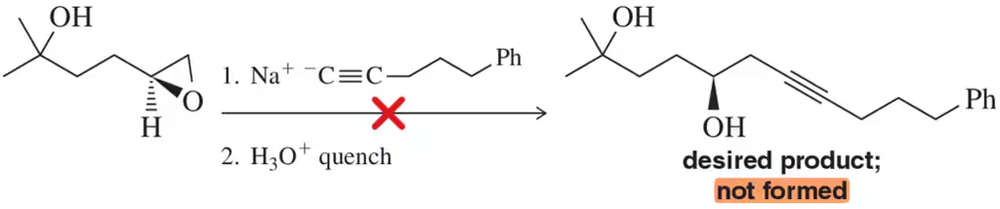
Reaction of the acetylide with the epoxide shown will not form the desired product. What side reaction occurs instead? Why?
Verified step by step guidance
1
Step 1: Understand the reactivity of acetylides. Acetylides are strong nucleophiles due to the negative charge on the carbon atom. They are also strong bases, which can lead to side reactions in the presence of acidic or proton-donating groups.
Step 2: Analyze the structure of the epoxide. Epoxides are three-membered cyclic ethers with significant ring strain, making them susceptible to nucleophilic attack. However, the reaction conditions and the nature of the nucleophile can influence the outcome.
Step 3: Consider the basicity of the acetylide. As a strong base, the acetylide can abstract a proton from any available acidic hydrogen in the reaction mixture, such as from water, alcohols, or other proton sources, instead of attacking the epoxide.
Step 4: Evaluate the competition between nucleophilic attack and proton abstraction. If proton abstraction occurs, the acetylide is converted into a neutral alkyne, which is no longer nucleophilic and cannot react with the epoxide to form the desired product.
Step 5: Conclude the side reaction. The side reaction involves the acetylide acting as a base and abstracting a proton, leading to the formation of an alkyne and preventing the desired nucleophilic attack on the epoxide.
Verified video answer for a similar problem:
This video solution was recommended by our tutors as helpful for the problem above
Play a video:
0 Comments
Key Concepts
Here are the essential concepts you must grasp in order to answer the question correctly.
Acetylide Nucleophiles
Acetylide ions are strong nucleophiles derived from terminal alkynes. They can attack electrophilic centers, such as carbon atoms in epoxides, leading to nucleophilic substitution reactions. However, their reactivity can also lead to side reactions, especially when the electrophile is sterically hindered or reactive in other ways.
Epoxides are three-membered cyclic ethers that are highly reactive due to the strain in their ring structure. They can undergo nucleophilic attack at the less hindered carbon atom, but if steric hindrance or other factors are present, the reaction may not proceed as expected. Understanding the regioselectivity of epoxide reactions is crucial for predicting the outcome of reactions involving acetylides.
Side reactions are unintended reactions that occur alongside the desired reaction, often leading to byproducts. In the case of acetylide and epoxide reactions, side reactions can occur due to the formation of more stable intermediates or competing pathways, such as ring-opening of the epoxide by other nucleophiles or elimination reactions. Recognizing these possibilities is essential for predicting reaction outcomes.

 Verified step by step guidance
 08:27
08:27