Identify the acid from which the following conjugate bases were formed. [The most basic atom is indicated.] (d)
Verified step by step guidance
1
Step 1: Recognize that the given structure represents the conjugate base of an acid. The conjugate base is formed when the acid donates a proton (H⁺).
Step 2: Analyze the structure provided. The image shows a chloride ion (Cl⁻), which is the conjugate base of hydrochloric acid (HCl).
Step 3: Recall the relationship between acids and their conjugate bases. Hydrochloric acid (HCl) donates a proton to form the chloride ion (Cl⁻).
Step 4: Understand that the most basic atom indicated in the image is the chloride ion (Cl⁻), which is negatively charged and stable due to its full octet of electrons.
Step 5: Conclude that the acid from which this conjugate base was formed is hydrochloric acid (HCl).
Verified video answer for a similar problem:
This video solution was recommended by our tutors as helpful for the problem above
Video duration:
1m
Play a video:
0 Comments
Key Concepts
Here are the essential concepts you must grasp in order to answer the question correctly.
Conjugate Acids and Bases
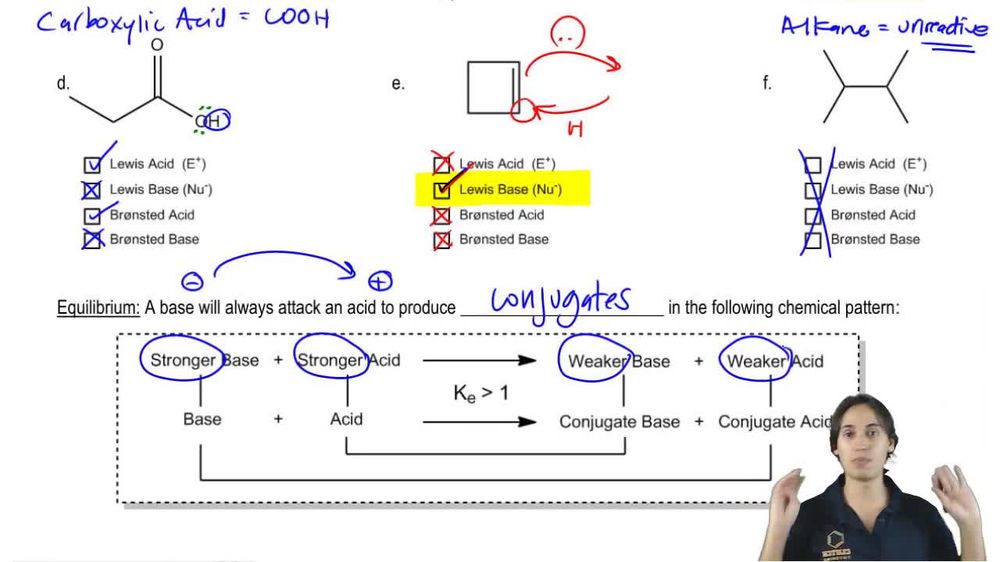
In acid-base chemistry, a conjugate base is formed when an acid donates a proton (H+). The relationship between acids and their conjugate bases is fundamental, as it helps to understand the strength and behavior of acids in reactions. For example, when hydrochloric acid (HCl) donates a proton, it forms its conjugate base, Cl-. Identifying the original acid from a given conjugate base is crucial for understanding acid-base equilibria.
The strength of an acid is determined by its ability to donate protons, while the basicity of its conjugate base is determined by its ability to accept protons. Strong acids have weak conjugate bases, and vice versa. In the context of the question, recognizing the most basic atom in the conjugate base can help identify the original acid, as it indicates the proton that was lost during the acid-base reaction.
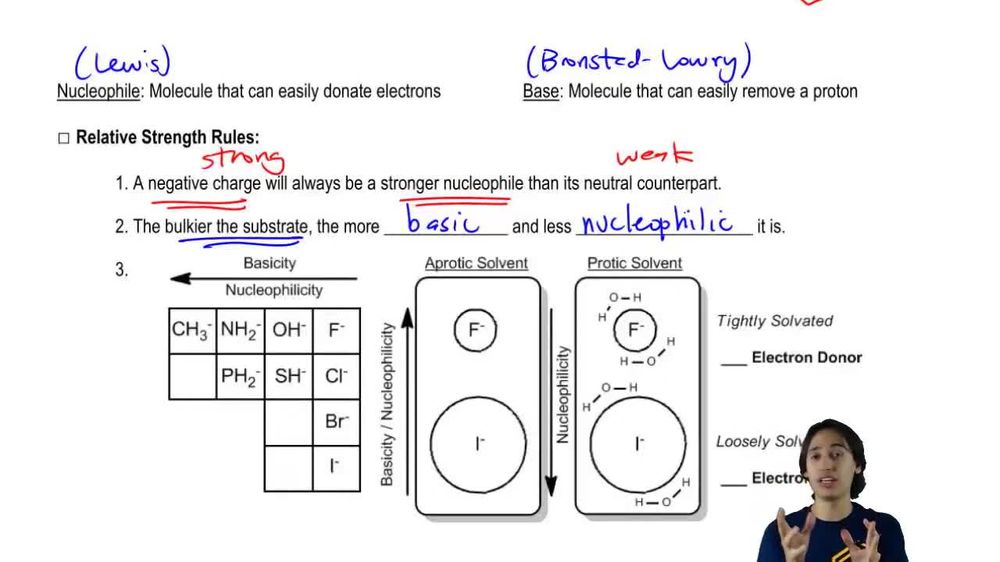
Understanding the difference between basicity and nucleophilicity.
Lewis Structures and Electron Configuration
Lewis structures are diagrams that represent the bonding between atoms and the lone pairs of electrons in a molecule. Understanding how to draw and interpret Lewis structures is essential for visualizing the electron distribution in acids and their conjugate bases. In the provided image, the arrangement of electrons around the chlorine atom can help deduce its behavior as an acid or base, aiding in the identification of the original acid.

 1:11 minutes
 Verified step by step guidance
 02:11
02:11