What is the conjugate base of each of the following acids? [The most acidic proton is indicated.] (a)
Verified step by step guidance
1
Identify the acid in the problem: The given acid is H₃O⁺ (hydronium ion), and the most acidic proton is indicated by the arrow.
Recall the definition of a conjugate base: The conjugate base is formed when the acid donates a proton (H⁺).
Remove the most acidic proton (H⁺) from H₃O⁺. This results in the chemical species H₂O (water).
Verify the charge: When H₃O⁺ loses a proton (H⁺), the positive charge is neutralized, resulting in a neutral molecule, H₂O.
Conclude that the conjugate base of H₃O⁺ is H₂O, as it is the species formed after the loss of the most acidic proton.
Verified video answer for a similar problem:
This video solution was recommended by our tutors as helpful for the problem above
Video duration:
3m
Play a video:
0 Comments
Key Concepts
Here are the essential concepts you must grasp in order to answer the question correctly.
Conjugate Acid-Base Pairs
In acid-base chemistry, a conjugate acid-base pair consists of two species that differ by the presence of a proton (H+). When an acid donates a proton, it forms its conjugate base, while the species that accepts the proton becomes the conjugate acid. Understanding these pairs is essential for predicting the outcome of acid-base reactions.
Acidity refers to the tendency of a substance to donate protons in a solution. The strength of an acid is often measured by its pKa value, which is the negative logarithm of its acid dissociation constant (Ka). A lower pKa indicates a stronger acid, meaning it more readily donates protons, which is crucial for identifying the most acidic proton in a molecule.
The hydronium ion (H3O+) is formed when an acid donates a proton to water, resulting in a positively charged ion. It is a key player in acid-base chemistry, as it represents the presence of protons in aqueous solutions. Recognizing H3O+ is vital for determining the conjugate base formed when it loses a proton, which in this case would be water (H2O).

 3:21 minutes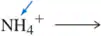
 Verified step by step guidance
 2:56
2:56