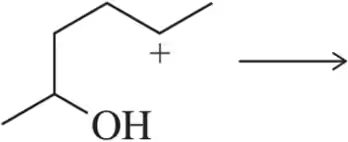
Predict the product of the following Lewis acid–Lewis base reactions. (d) [an intramolecular reaction]
Verified step by step guidance
1
Step 1: Identify the Lewis acid and Lewis base in the reaction. In this case, the positively charged carbon atom (carbocation) is the Lewis acid, and the hydroxyl group (-OH) is the Lewis base.
Step 2: Recall that a Lewis acid is an electron pair acceptor, while a Lewis base is an electron pair donor. The hydroxyl group (-OH) has lone pairs of electrons on the oxygen atom, which can be donated to the carbocation.
Step 3: Predict the interaction between the Lewis acid and Lewis base. The lone pair of electrons from the oxygen atom in the hydroxyl group will form a bond with the carbocation, resulting in a new covalent bond.
Step 4: Consider the structure of the product. The oxygen atom from the hydroxyl group will now be directly bonded to the carbon atom that was previously the carbocation. This forms a new ether-like structure.
Step 5: Ensure the product is stable. Verify that all atoms in the product have complete octets and that the formal charges are minimized. The oxygen atom will likely retain a positive charge due to the bonding interaction.
Verified video answer for a similar problem:
This video solution was recommended by our tutors as helpful for the problem above
Video duration:
2m
Play a video:
0 Comments
Key Concepts
Here are the essential concepts you must grasp in order to answer the question correctly.
Lewis Acids and Bases
Lewis acids are electron pair acceptors, while Lewis bases are electron pair donors. In a Lewis acid-base reaction, the base donates an electron pair to the acid, forming a coordinate covalent bond. Understanding this concept is crucial for predicting the products of reactions involving these species, as it determines how they interact and the resulting molecular structures.
Resonance structures are different ways of drawing the same molecule that illustrate the delocalization of electrons. In the context of Lewis acid-base reactions, recognizing resonance can help predict the stability of intermediates and products. This is particularly important when dealing with charged species, as resonance can stabilize positive or negative charges, influencing the reaction pathway.
Nucleophilicity refers to the ability of a species to donate an electron pair, while electrophilicity refers to the ability of a species to accept an electron pair. In the given reaction, the hydroxyl group (OH) acts as a nucleophile due to its lone pairs, while the positively charged site acts as an electrophile. Understanding these properties is essential for predicting the direction and outcome of the reaction.